



The rediscovery of the sailback shark
One of the most surprising rediscoveries in marine biology recently occurred in Papua New Guinea, Oceania. They detected a specimen of a species believed to be extinct: the sailback shark or cookiecutter shark (Gogolia filewoodi).
It was found again after over half a century of absence in scientific records.
The species, considered one of the rarest in the world, had last been seen in 1973 and since then it was believed to be possibly extinct or reduced to a minimal population.
The sailback shark, an enigmatic species
The sailback shark is distinguished by its large dorsal fin, much more prominent than that of other similar species. It was first described in 1973 when a pregnant female was captured in Astrolabe Bay, near the Gogol River.
For decades, that was the only formal record of the animal, which increased the mystery surrounding its existence.
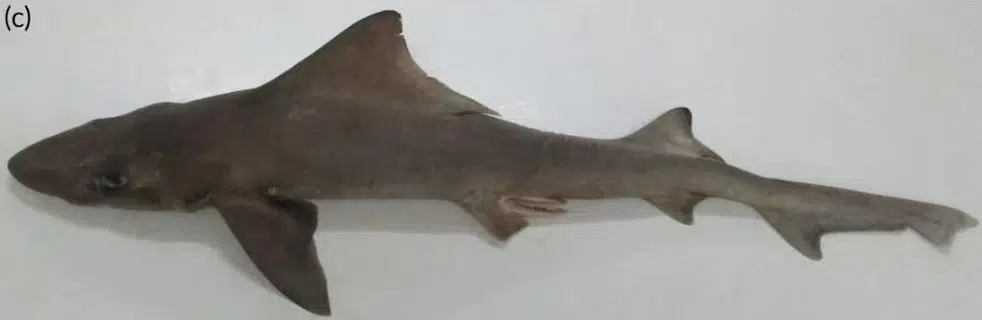 The sailback shark. (Photo: Journal of Fish Biology).
The specimen’s discovery
The rediscovery took place within a project led by Jack Sagumai and his team from the World Wide Fund for Nature in the Pacific, published in the Journal of Fish Biology.
In March 2020, by analyzing photographs taken by local fishermen at the mouth of the Gogol River, the researchers identified five small sharks with the characteristic dorsal fin. All of them were females under one meter long.
In 2022, a new record provided even more evidence: a fisherman caught a male of the species near Astrolabe Bay.
Although for science these findings represent the first formal records in over five decades. The region’s inhabitants claim that the sailback shark occasionally appears during fishing activities, especially near groupers.
The observations suggest that the Gogolia filewoodi could be a microendemic species, limited to a small area of Astrolabe Bay and nearby areas.
However, some specialists suggest that in the past, it may have had a broader range in the waters of Indonesia and Papua New Guinea, currently remaining as a remnant population.
The region is known to host other sharks with very restricted distributions, such as the bamboo and epaulette sharks, which reinforce both hypotheses.
Next steps for the conservation of the sailback shark
The biology of the sailback shark remains a great mystery: so far, only two deceased specimens have been preserved at the University of Papua New Guinea, limiting direct studies.
In response to this situation, researchers are promoting new campaigns alongside experts from Australia and Florida, with the aim of conducting genetic analyses to build a database of the species.
This work will be crucial to monitor the population, assess its genetic diversity, and design conservation plans against threats such as fishing, environmental changes, and prey availability.
 The specimen was detected in Papua New Guinea.
A second chance for science
The rediscovery of the sailback shark demonstrates the importance of collaboration between local communities and international scientists in biodiversity conservation.
This finding not only brings hope against the disappearance of understudied species but also opens a new research stage to ensure the protection of one of the rarest and most mysterious sharks in the Pacific.



