



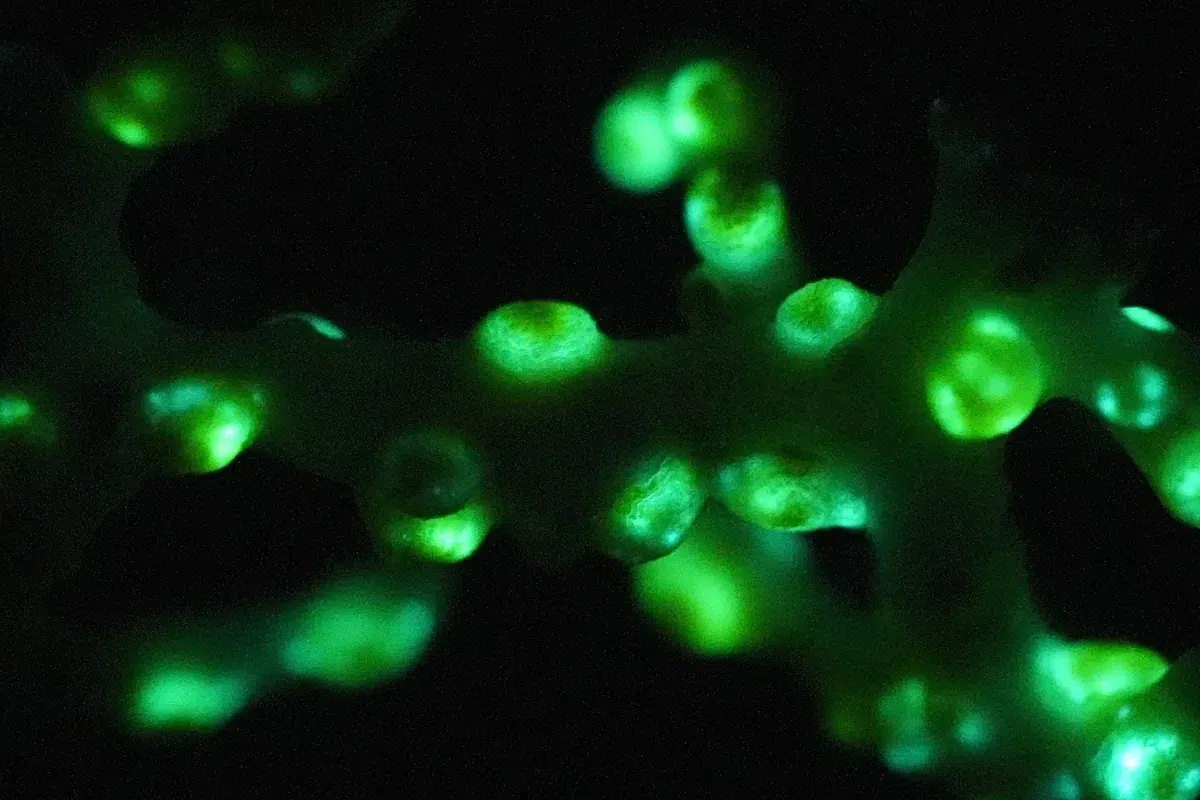
In an underwater cave located at 400 meters deep near the Japanese island of Minamidaito, a team of researchers documented for the first time a case of bioluminescence in deep-sea corals. The discovery, published in Royal Society Open Science, revealed an unknown species named Corallizoanthus aureus, capable of emitting a green glow in complete darkness.
This finding sets a scientific precedent, as bioluminescence had been observed in fish, jellyfish, and other abyssal organisms, but never in corals that inhabit marine caves.
Distinctive Features of the New Species
The coral colony presents unprecedented morphological characteristics:
- It belongs to the genus Corallizoanthus.
- Under artificial lighting, it shows a golden hue, which is the origin of the name aureus.
- The polyps emit a green intermittent luminescence when stimulated tactilely or chemically.
- The stolon, the tissue connecting the polyps, did not show luminous activity, suggesting a localized and specialized function.
Bioluminescence as a Defense Strategy
The green light is a response to an internal chemical reaction that releases energy in the form of visible light. Researchers suggest that this flash could act as a defense mechanism: by illuminating the predator in the dark, the coral would increase its exposure to larger species, generating a chain reaction within the cavernous ecosystem.
This behavior raises new questions about ecological interactions in environments where sunlight never reaches and where bioluminescence can become a vital resource.
Scientific and Ecological Implications
The finding has several implications:
- Exploration and conservation: deep caves could harbor more unknown species, necessitating a balance between research and protection.
- Hidden diversity: demonstrates how much of the ocean remains undocumented, even with advanced cameras.
- Biological classification: could redefine how scientists group corals and other marine organisms.
Moreover, this discovery reinforces the importance of remotely operated vehicles (ROV) and fiber optic chemical stimulation techniques, which allowed validating the bioluminescence without altering the natural environment.
Next Steps in Research
The study’s authors indicate that it will be necessary to:
- Conduct new expeditions to underwater caves in different regions.
- Apply careful chemical tests to better understand the biological function of luminescence.
- Evaluate how this finding can influence the conservation of abyssal ecosystems, increasingly threatened by exploration and resource extraction.
The discovery of Corallizoanthus aureus constitutes a scientific milestone without precedent, documenting the first bioluminescence in deep cave corals. Beyond its spectacular nature, this finding underscores the importance of exploring and conserving abyssal ecosystems, where secrets capable of rewriting our understanding of marine life still lie hidden.

