



An apparently ordinary rock on the coast of **Japan** contained an unknown story of **marine life in the age of dinosaurs**. A study led by the **Hokkaido University** and published in *Science* revealed the existence of at least **40 new species of squids**, some of large size, that challenge the traditional model of **mesozoic ocean evolution**.
The finding reveals that squids were not mere survivors after the **extinction of the Cretaceous** 66 million years ago, but **predators already dominant 34 million years earlier**, around the **Late Cretaceous**, about **100 million years ago**.
## Abrasion tomography technique: a digital window to the fossil past
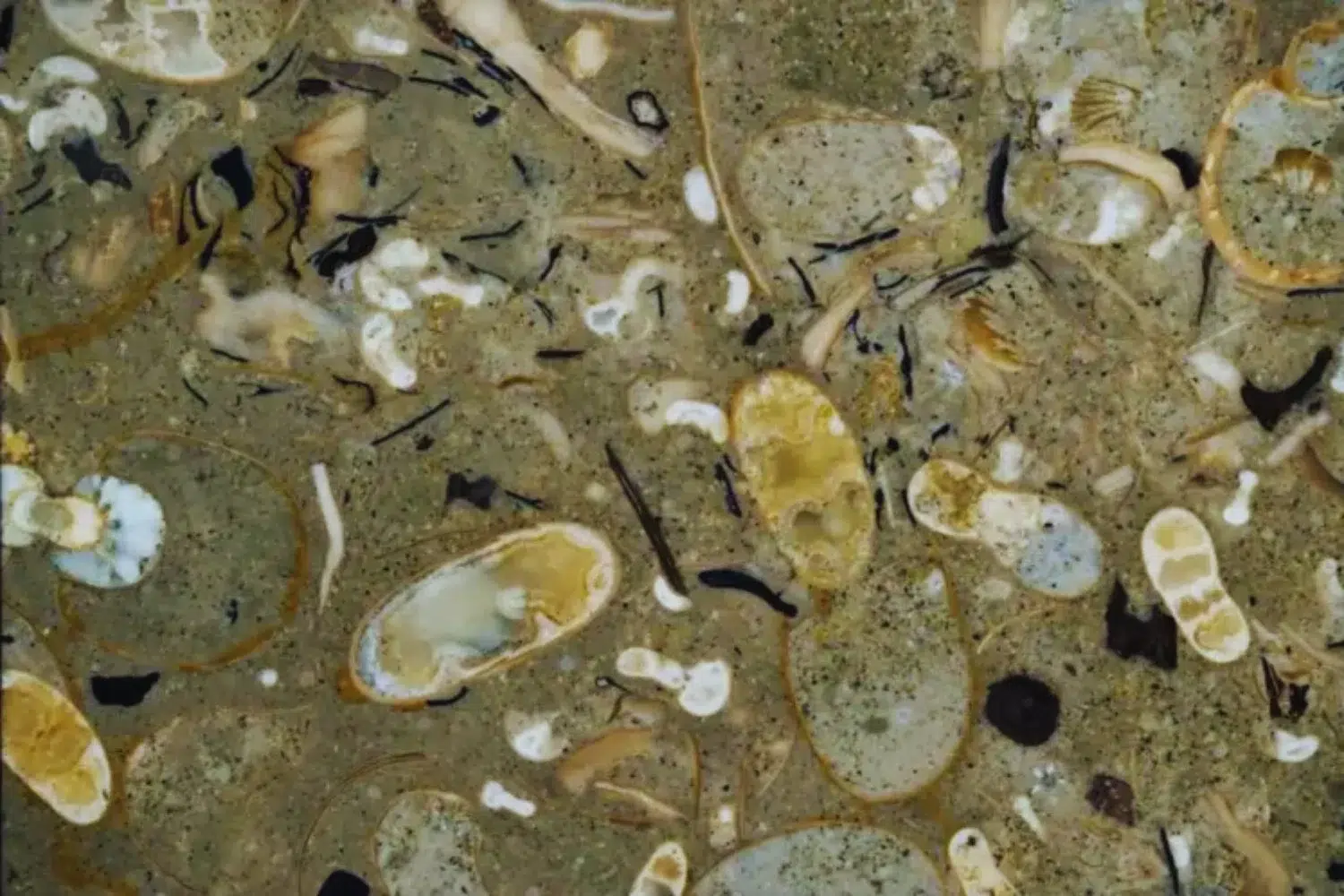
The rocky block was explored using an advanced technique called **abrasion tomography**, which involves grinding layer by layer of the rock, scanning it in high resolution, and reconstructing its content **three-dimensionally**. This allows to:
– Detect microfossils without destroying them by traditional cutting
– Generate digitally explorable 360° models
– Preserve the detail of fragile structures
Within the block, the following were identified:
– About **1,000 cephalopod beaks**, highly resistant chitin structures
– **263 specimens** classified as squids
– At least **40 species with no previous record**
The beaks, curved hook-shaped, do not exceed **10 microns in thickness**, explaining their invisibility in previous techniques.
## Cretaceous trophic network: new squid species
The surprising thing was not only the abundance, but **the size and morphology** of the squids:
– Some were **as large as the fish** with which they shared habitat
– They exceeded in length the famous **ammonites**, considered great swimmers of the Mesozoic
The variety of forms suggests an **explosive evolutionary radiation**, with squids **adapted to multiple ecological niches**, from coastal areas to open sea.
Two lineages of **modern cephalopods** were identified:
– **Myopsida**: coastal waters
– **Oegopsida**: pelagic oceans
Their presence in fossils from 100 million years ago **anticipates the evolution of the group much earlier than expected**.
## From specific fossil to microrecord
This finding transcends the mere accumulation of fossils and represents a new era in marine paleontology:
– Bets on **microrecords** over spectacular but isolated fossils
– Redraws Mesozoic marine ecosystems with **greater ecological precision**
– Projects **Japan as a global reference** in the study of marine microfossils
“What was once invisible is now reconstructible. And what we imagined as oceans dominated by ammonites or marine reptiles, perhaps were complex realms ruled by intelligent and swift squids,” say the researchers.
*Cover photo: AI*


