



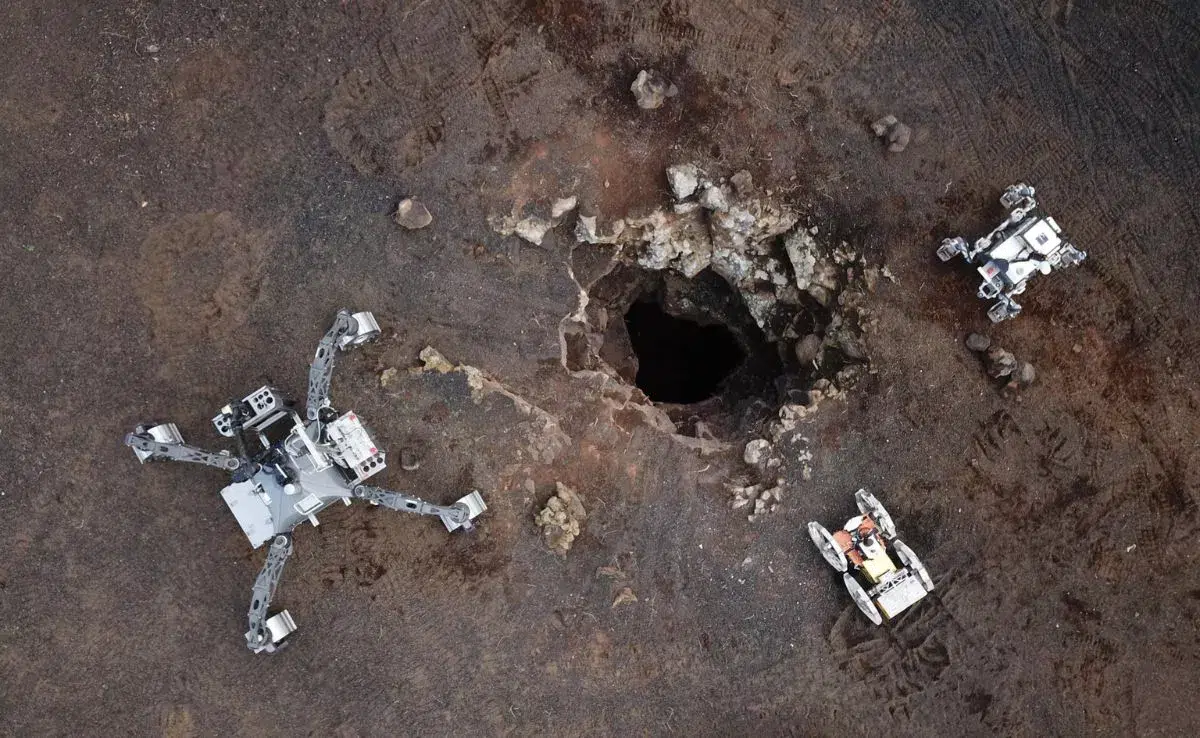
A European research consortium conducted an unprecedented technological test: introducing an autonomous robotic system into a volcanic lava tube in Lanzarote.
This extreme environment, considered analogous to the conditions on the Moon and Mars, allowed for the validation of technologies that could be key for space colonization. The study was published in the journal Science Robotics and reinforces the role of robotics in planetary exploration.
Caves as natural shelters
The research is based on a clear premise: the underground cavities detected on other planetary bodies could serve as shelters against cosmic radiation and micrometeorite impacts. However, their direct exploration is complex due to irregular geology, lack of light, and the impossibility of immediate human intervention.
Autonomous robotic cooperation
The project, led by the German Research Center for Artificial Intelligence, involved the participation of the Space Robotics Laboratory of the University of Málaga and the Spanish technology company GMV. The system was designed to operate without direct supervision and was structured in four stages:
- Initial mapping of the area near the tube entrance.
- Release of a cubic module with sensors to obtain preliminary data.
- Controlled descent of an explorer rover by rappelling, accessing areas inaccessible from the surface.
- Cooperative traversal of the robots to generate detailed three-dimensional models of the interior.
Test results
The results confirmed that cooperative autonomous exploration is viable even in extreme conditions.
This approach would allow for the assessment of the stability and size of lava tubes before using them as habitats for astronauts, reducing risks in future manned missions.
Spain as a relevant player
The Space Robotics Laboratory of the University of Málaga emphasized that such developments not only drive planetary exploration but also position Spain as a key player in technological preparation for lunar and Martian colonization scenarios.
The test in Lanzarote demonstrates that autonomous robotics can open new avenues for space exploration. Lava tubes, both on Earth and on other planetary bodies, are emerging as strategic spaces to protect future settlers from radiation and external impacts.
The cooperation between European institutions reinforces the idea that the colonization of the Moon and Mars will be a collective effort, where robotic technology will play a central role.



