



The Earth is experiencing one of the most intense solar storms of the last 22 years. A coronal mass ejection, driven by an extreme flare, moved at high speed from the Sun.
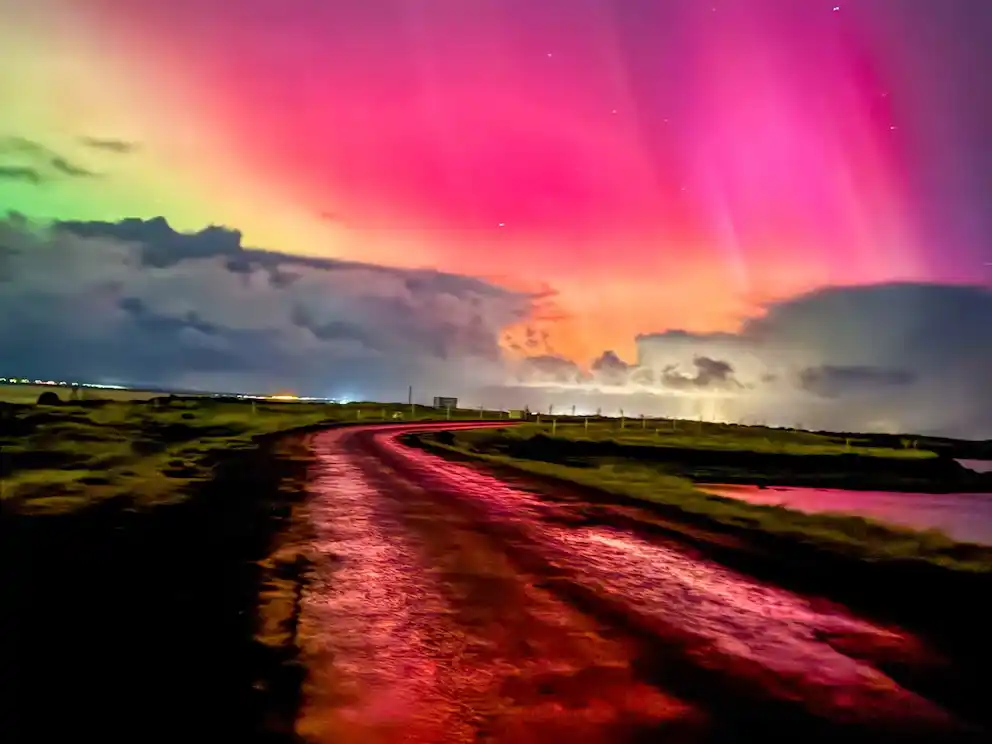
As a result, space weather alerts were activated and visible effects began to be observed. Among them, auroras at unusual latitudes and preventive protocols in critical infrastructures.
This event did not occur in isolation. It is part of an ascending phase of the solar cycle, which alternates periods of calm with others of strong activity.
Geomagnetic alert and global monitoring
Before the impact, monitoring systems raised the warning to a possible G4 level geomagnetic storm. This is a category associated with significant risks for power grids and satellites.
At this level, some protection systems may disconnect key components. This decision seeks to avoid major damage, although it increases the likelihood of temporary disruptions.
The phenomenon originated in an active region of the Sun with large sunspots. Therefore, specialists do not rule out new episodes in the coming days.
What is a solar storm and how does it interact with the Earth?
A solar storm occurs when the Sun releases large amounts of plasma and magnetic fields. These clouds travel through space and, if directed at Earth, impact the magnetosphere.
This natural shield protects the planet from cosmic radiation. However, when disturbed, it generates induced electrical currents in space and on the surface.
In this case, the flare was class X, the most intense on the scale. Upon reaching the magnetosphere, it altered the magnetic field and caused a global geomagnetic storm.

The environmental implications of the solar storm
From an ecological perspective, solar storms remind us of the fragility of the planetary balance. The magnetosphere plays a key role in deflecting harmful energetic particles for life.
When this shield is altered, radiation increases in the upper layers of the atmosphere. Although the direct effects on terrestrial ecosystems are limited, the phenomenon is relevant on a global scale.
Additionally, these storms influence atmospheric chemistry and the ionosphere. This can temporarily modify processes related to communications and environmental observation by satellite.
Technological risks and a lit-up sky
The increase in radiation poses challenges for satellites, navigation, and aviation. Polar routes may experience interference and power grids remain under constant observation.
At the same time, the event offered an unusual natural spectacle. Auroras extended to regions far from the poles, illuminating the night sky.
These lights occur when solar particles collide with oxygen and nitrogen in the atmosphere. Thus, the solar storm showed its dual face: risk to technology and a reminder of the link between the Sun and the Earth.



