



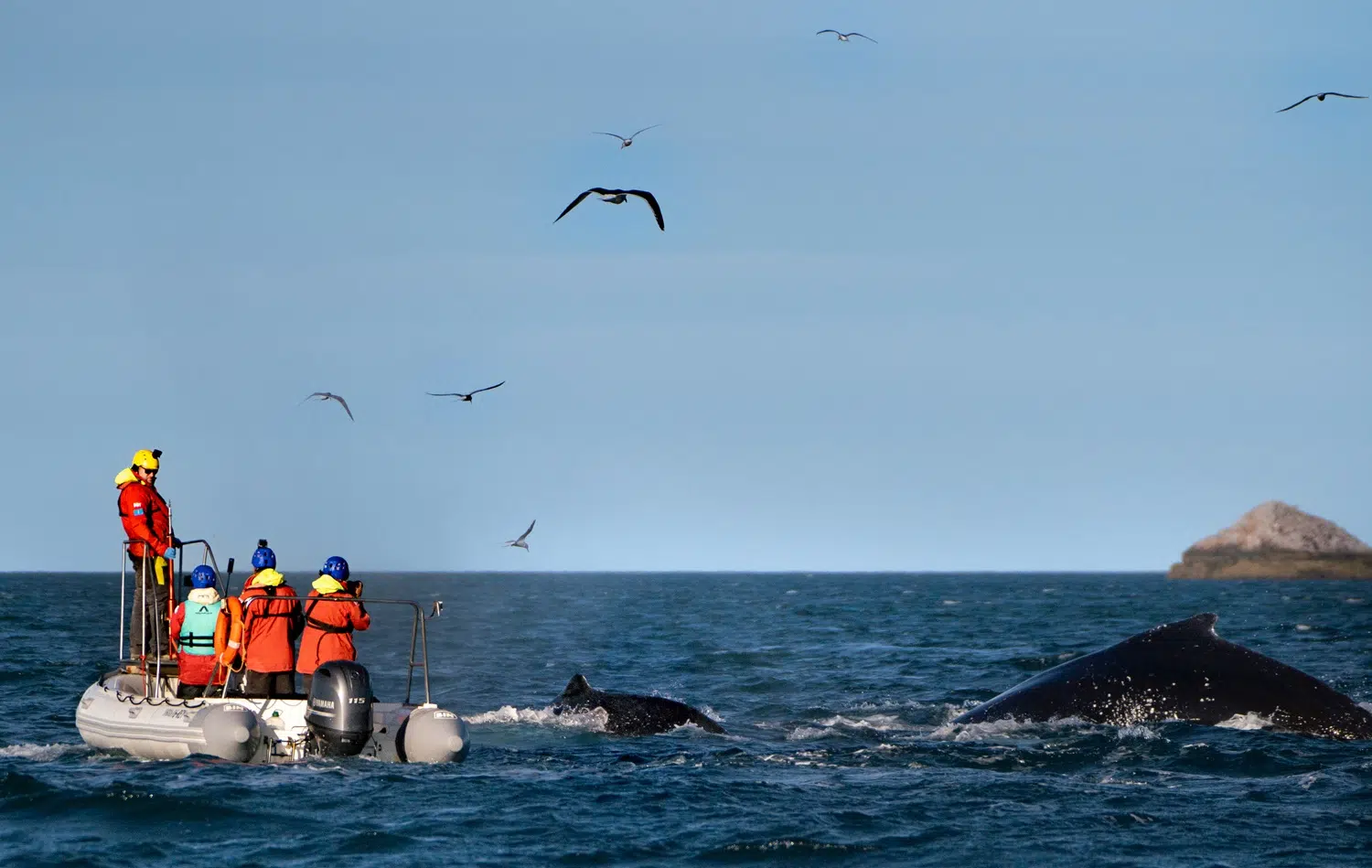
Just five years ago, spotting a humpback whale off the coast of Chubut was a rarity. Today, the Provincial Park Patagonia Azul, in Camarones, has become a key feeding point for this species, which had never been recorded in the area before.
The discovery is transforming the paradigms of marine biology and generating a new scientific catalog.
The Beginning of the Record
Biologist Lucas Beltramino, from the Patagonia Azul Project, began in 2021 to collect images of the cetaceans’ tails. By uploading them to the international database HappyWhale, they discovered surprising matches: individuals recorded in Chubut had previously been photographed in Brazil.
Thus, a catalog was born that today has more than 100 identified individuals, of which at least 80 are new to science.
An Unprecedented Route
Until now, satellite tracking indicated that populations traveled directly to the South Georgia Islands. However, records in Patagonia Azul show that the humpbacks remain for long periods near the coast, also visiting the Beagle Channel, the Antarctic Peninsula, and the Brazilian coasts.
The main reason is feeding: scientists documented specimens that return year after year and stay in Chubut for more than three months. Additionally, they observed unprecedented social behaviors, such as pairs of whales swimming together for weeks without separating, outside the classic mother-calf bond.
Satellite Technology
To delve deeper into the phenomenon, the team placed satellite trackers on three humpbacks and two sei whales.
The data reveals that the animals spend almost 90% of their time within the park, although one of them inaugurated an unprecedented migratory route to the Antarctic Peninsula, recently passing south of the Falkland Islands.
An Ecological Puzzle
The discovery raises questions about the origin of this population and the reasons for their settlement in Patagonia.
Initial biopsy analyses suggest a strong presence of females, although the sample still needs to be expanded. What is certain is that this phenomenon, unknown until five years ago, is rewriting the ecological history of the province and the Argentine Sea.
The record of humpback whales in Chubut is a historic milestone that combines science, conservation, and surprise. Each photograph and each satellite tracking contribute pieces to a puzzle that reveals new migratory routes and unprecedented social behaviors. Patagonia Azul is consolidating as a key stage for understanding the dynamics of these ocean giants.



