



In the depths of the Arctic Ocean, where light does not reach and pressure crushes, scientists have discovered a phenomenon that defies evolutionary logic: an invisible barrier that certain jellyfish never cross.
It is not a physical wall or a continental shelf, but an intangible boundary, delineated by ocean currents and pressure systems, crossing the North Atlantic as if it were a silent underwater cord.
Botrynema brucei ellinorae: a jellyfish, two forms, two territories
The protagonist of this enigma is the jellyfish Botrynema brucei ellinorae, a translucent creature that inhabits the abyssal zones of the ocean.
According to a study published in Deep Sea Research Part I, this species has two morphotypes: one with a bulge on the hood and another without it.
The puzzling aspect is that, although they are genetically identical, specimens without a bulge never appear south of the 47th parallel north, while their counterparts with a bulge do cross that line.
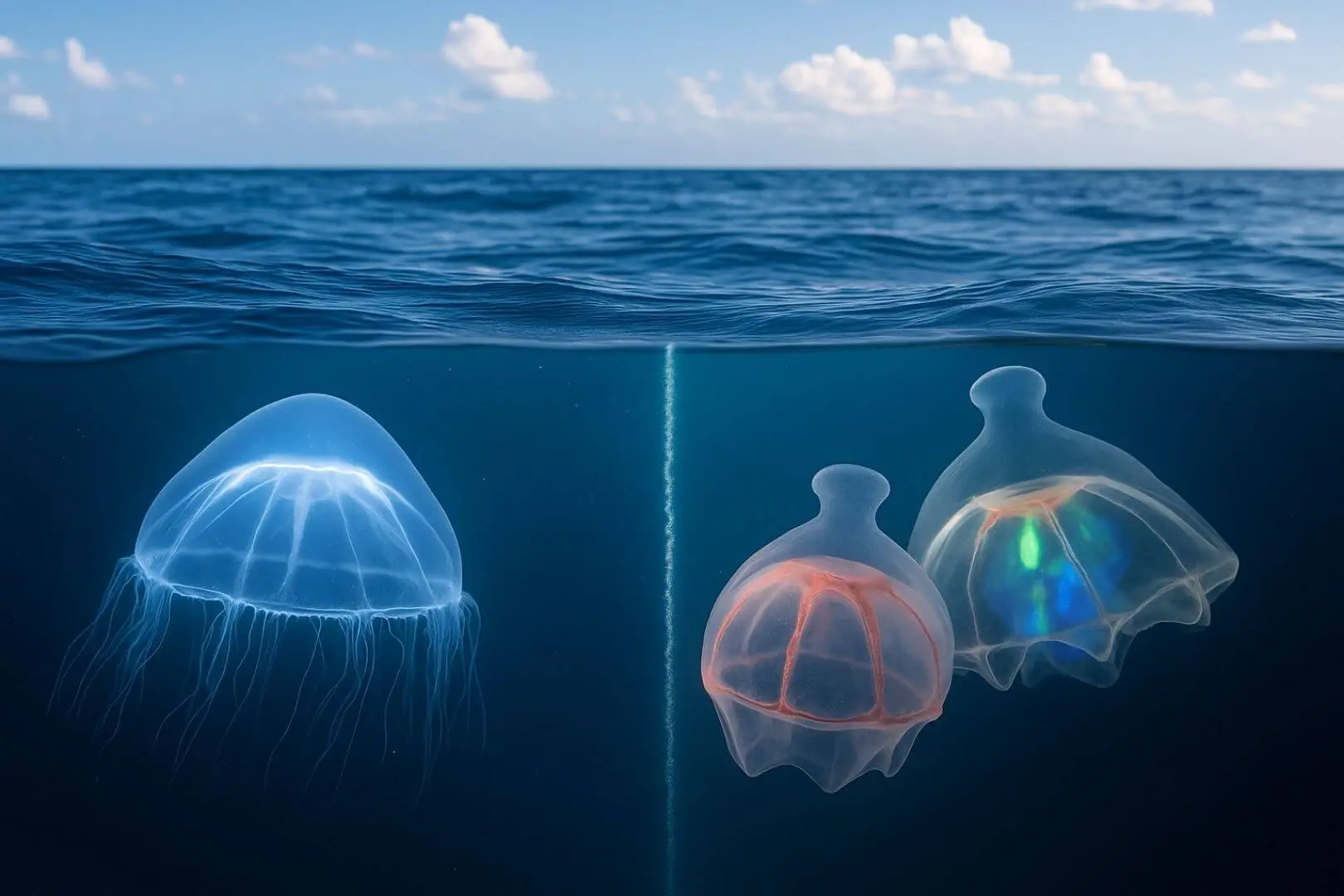 Jellyfish Botrynema brucei ellinorae
A biogeographical boundary in the depths
The team led by Dr. Javier Montenegro, from the University of Western Australia, analyzed historical records, underwater photographs, and genetic data to map the global distribution of this jellyfish.
The result was clear: no specimen without a bulge crosses the North Atlantic current, which extends from the Grand Banks of Newfoundland to northwest Europe.
This finding suggests the existence of a semipermeable biogeographical barrier, similar to other ecological divisions like the Wallace Line in Southeast Asia, separating Asian fauna from Australian fauna. However, this Arctic version is even more enigmatic due to its theoretical and underwater nature.
Evolutionary advantage or environmental restriction?
One of the most plausible hypotheses is that the bulge on the hood could provide a selective advantage to jellyfish that possess it, allowing them to survive in warmer regions or with a higher presence of predators.
“It could keep specimens without a bulge confined to the north, while allowing specimens with a bulge to freely transit further south,” explains Montenegro.
This type of morphological differentiation, without significant genetic divergence, raises profound questions about evolutionary plasticity, environmental pressure, and marine habitat segmentation.
The Arctic Ocean as a mosaic of invisible boundaries
Most fascinating is that these jellyfish, organisms without a central nervous system, seem to follow rules they cannot even perceive.
Their behavior reveals that the ocean is not a continuous mass of water, but a network of hidden territories, where ecological boundaries are drawn without walls, but with profound evolutionary consequences.
Cover photo: Muy Interesante



