



Scientists confirmed a new **[paleontological discovery](https://noticiasambientales.com/ciencia/hallazgo-en-san-juan-tres-especies-de-aves-prehistoricas/)** in Santa Cruz and the details will be officially announced very soon.
The materials from this discovery by **CONICET** collected in 2020 by a team of scientists from the **[Museo Argentino de Ciencias Naturales (MACN)](https://www.macnconicet.gob.ar/)**.
The campaign took place 30 kilometers from **El Calafate** and was carried out by the **Laboratorio de Anatomía Comparada y Evolución de los Vertebrados**.
### An important discovery for Argentine paleontology
However, the expedition was interrupted by the **coronavirus pandemic**. During that period, the group of paleontologists and technicians were isolated in the Santa Cruz locality before being able to return to Buenos Aires.
Based on the remains collected during that campaign, the researchers confirmed that a new scientific discovery will be announced, promising to expand knowledge about the **[ecosystems of Argentine Patagonia](https://noticiasambientales.com/ciencia/cientificas-argentinas-lideran-una-exploracion-inedita-de-canones-submarinos-de-la-patagonia-y-la-corriente-de-malvinas/#google_vignette)**.
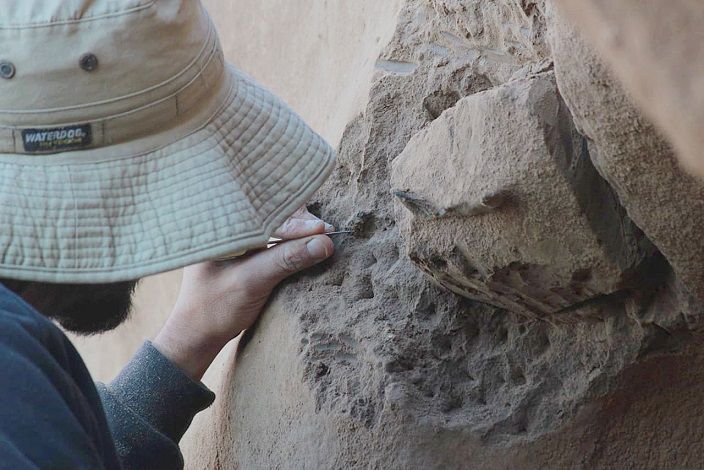
This announcement adds to other recent findings in the region. In February 2023, Dr. **Fernando Novas** presented the **Patagorhynchus pascuali**, the first **fossil platypus in South America**. At that time, the renowned paleontologist had already hinted at least two more discoveries in preparation.
“We have been working with very valuable findings that will allow us to make several publications in the environmental, geological, and paleontological fields. They will be new pieces that add to this ecosystem, and I am sure they will generate great interest when they are presented,” Novas said in previous statements.
### The public presentation in Río Gallegos
The new **[discovery in Santa Cruz](https://noticiasambientales.com/ciencia/hallazgo-en-san-juan-tres-especies-de-aves-prehistoricas/)** will be officially presented in an **[open talk](https://noticiasambientales.com/ciencia/hallazgo-en-san-juan-tres-especies-de-aves-prehistoricas/)** by Dr. Fernando Novas this **Thursday, August 28 at 6:00 p.m.** at the **Salón Auditorio Luis Villareal del Complejo Cultural Santa Cruz**, located at José Ingenieros 60, Río Gallegos.
The conference will be a unique opportunity for the community to firsthand learn about the advances of Argentine paleontology and the fossil wealth of Patagonia, one of the **[most relevant regions in the world for scientific discoveries](https://noticiasambientales.com/ciencia/hallazgo-en-san-juan-tres-especies-de-aves-prehistoricas/)**.
### Landmarks of Argentine science: the incredible discovery of prehistoric birds in San Juan
An Argentine team of **paleontologists** identified **three new species of prehistoric birds** in the **Valle de Calingasta**, west of **San Juan**, providing key information about a **[vanished ecosystem](https://noticiasambientales.com/medio-ambiente/bahia-de-florida-restaurar-los-everglades-para-salvar-el-ecosistema/)**.
The discovery was released this year. Led by **CONICET researchers** and published in the journal **Historical Biology**, it allows us to go back **seven million years** to understand how **climate change transformed the landscapes** of the region.
They are three completely new species for science:
– **Hunucornis huayanen**: a diving macaw, similar to a duck but adapted to **subaquatic life**. Its name combines **”Hunuc”**, the animal protective deity according to the **Huarpe**, with the **Huayán** people.
– **Zqueheanas hebe**: a duck related to **cauquenes**, a resident of **shallow waters**. Its name pays tribute to **Hebe de Bonafini**, a human rights advocate.
– **Palaelodus haroldocontii**: an extinct relative of modern **flamingos**, with a **slender, pointed beak**, ideal for consuming **insects and mollusks**. Its name honors the writer **Haroldo Conti**, who disappeared during the dictatorship.



