



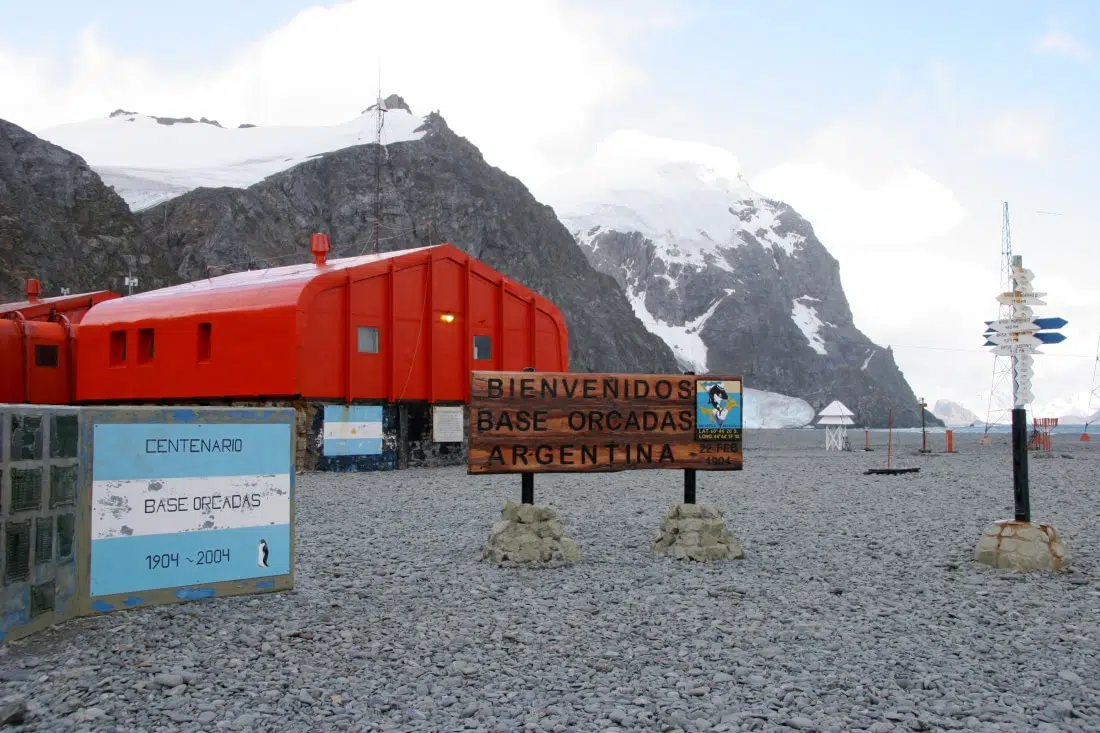
The Orcadas Base, located on Laurie Island in the South Orkney Islands archipelago, is the oldest scientific station in operation in Antarctica. Since 1904, it has been the longest-standing human presence on the white continent, establishing Argentina as a pioneer in polar research.
On February 22, 1904, the Scottish expedition led by William Speirs Bruce officially transferred the base to the Argentine government, which accepted the operation by decree. Since then, the Argentine flag has flown uninterruptedly in an environment of extreme temperatures and unique landscapes.
History and Heritage
The foundation dates back to 1903 when Bruce installed the first structures. The transfer to Argentina was completed in 1904, a date now celebrated as Argentine Antarctica Day. Among the first members of the crew was Hugo Acuña, one of the first winterers on the continent.
The Omond House, built of stone, is still preserved as a historical heritage. Decades later, the Moneta House was added, now converted into a museum and recognized as a Historic Site and Monument by the Antarctic Treaty.
Advancements and Milestones
The base was the scene of technological innovations, such as the installation of a radiotelegraph station, which enabled the first direct communications between Antarctica and the Argentine mainland. In 1946, the first Catholic mass on the continent was celebrated there, reflecting the social life that developed under extreme conditions.
Scientific Research
Orcadas is a vital center for Antarctic science. Studies are conducted in its laboratories:
- Meteorological: to understand polar atmospheric dynamics.
- Glaciological: on the behavior of glaciers and their global impact.
- Biological: on species adapted to extreme conditions.
The climate is harsh, with an average annual temperature of -5 °C. In the surroundings, colonies of Adelie and Chinstrap penguins, Weddell seals, sea lions, and birds native to the Antarctic ecosystem can be observed.
Life at the Base
Logistics are managed by the Argentine Navy, ensuring supply and security. Living together requires discipline and cooperation, as isolation and weather conditions are constant challenges.
For scientists and technicians, the experience at Orcadas is a unique opportunity to contribute to global knowledge about Antarctica.
International Value
Although not open to conventional tourism, the base receives official and educational visits. The Moneta House, converted into a museum, is recognized as a historical monument by the international community.
The continuous operation for more than 120 years represents a significant contribution from Argentina to polar research and scientific diplomacy. According to the National Antarctic Directorate, “the uninterrupted presence of the Orcadas Base is a demonstration of Argentina’s commitment to peace, science, and environmental preservation in Antarctica.”
The Orcadas Base is much more than a scientific station: it is a symbol of Argentina’s presence in Antarctica, a historical legacy, and a key research center for understanding the planet’s climate and ecosystems. Its continuity reaffirms the commitment to science and international cooperation in one of the world’s most challenging territories.


