



A study led by the Institute of Marine Sciences of Andalusia (Icman-CSIC), together with the University of Cádiz and the University of the Basque Country, revealed that the extent of red algae in Antarctica is much greater than previously thought.
After six years of observations in the South Shetland archipelago, researchers concluded that the blooms affect between 3% and 12% of each island, reaching a maximum area of 176 km², a figure that far exceeds previous records.
Pink snow and accelerated melting
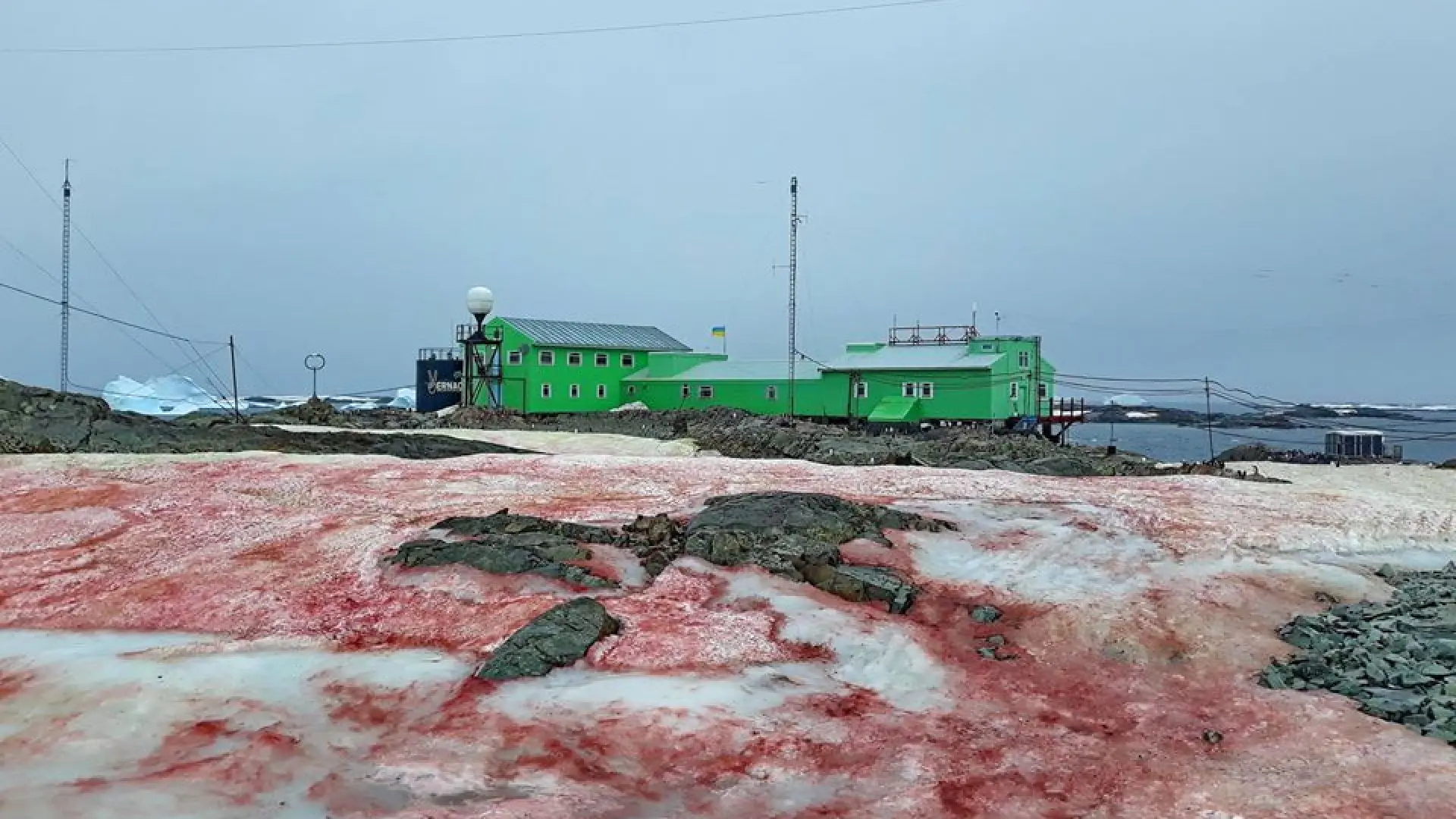
Microalgae, known as “red algae”, proliferate during the austral summer, tinting the snow a pinkish hue in a phenomenon called “pink snow”. This color change is not just visual:
- It reduces the surface albedo by up to 20%, decreasing the snow’s ability to reflect solar radiation.
- It increases solar energy absorption, accelerating the melting of snow and ice.
- It generates a positive feedback loop: the melting favors the growth of algae, which in turn intensify the melting.
Scientific bases and Spanish relevance
The study was conducted in a strategic area for Spanish polar science, where the bases Gabriel de Castilla (Deception Island) and Juan Carlos I (Livingston Island) are located. Blooms were observed both on glaciers and in coastal snow areas and ice caps.
The lead researcher, Alejandro Román, highlighted the need for longer time series to confirm the trend, although current data already show territorial and temporal expansion between 2018 and 2024.
Advanced technology to map the algae
The team employed a combination of state-of-the-art tools:
- Sentinel-2 satellites to capture large-scale images.
- Hyperspectral sensors mounted on drones to record spectral properties at different wavelengths.
- Artificial intelligence and machine learning to analyze 45 cloud-free images and accurately map the distribution of the algae.
For the first time, an open hyperspectral database was built on these algae in Antarctica, which will allow for the identification and classification of their land cover in future satellite images.
Implications for climate change
The study, published in Communications Earth & Environment, shows that red algae blooms are not isolated local events, but large-scale processes capable of altering the energy balance and melting patterns in coastal areas of the white continent.
The information obtained provides tools to:
- Continuously monitor the evolution of polar ecosystems.
- Evaluate the impact of microorganisms on ice stability.
- Develop automatic remote sensing systems to track blooms and their influence on ecological and climatic processes.
Red algae in Antarctica represent a far-reaching phenomenon that accelerates melting and reinforces the continent’s vulnerability to global warming.
Thanks to the combination of satellites, drones, and artificial intelligence, science now has a solid foundation to understand how these microorganisms influence polar dynamics and the future of the planet.



