



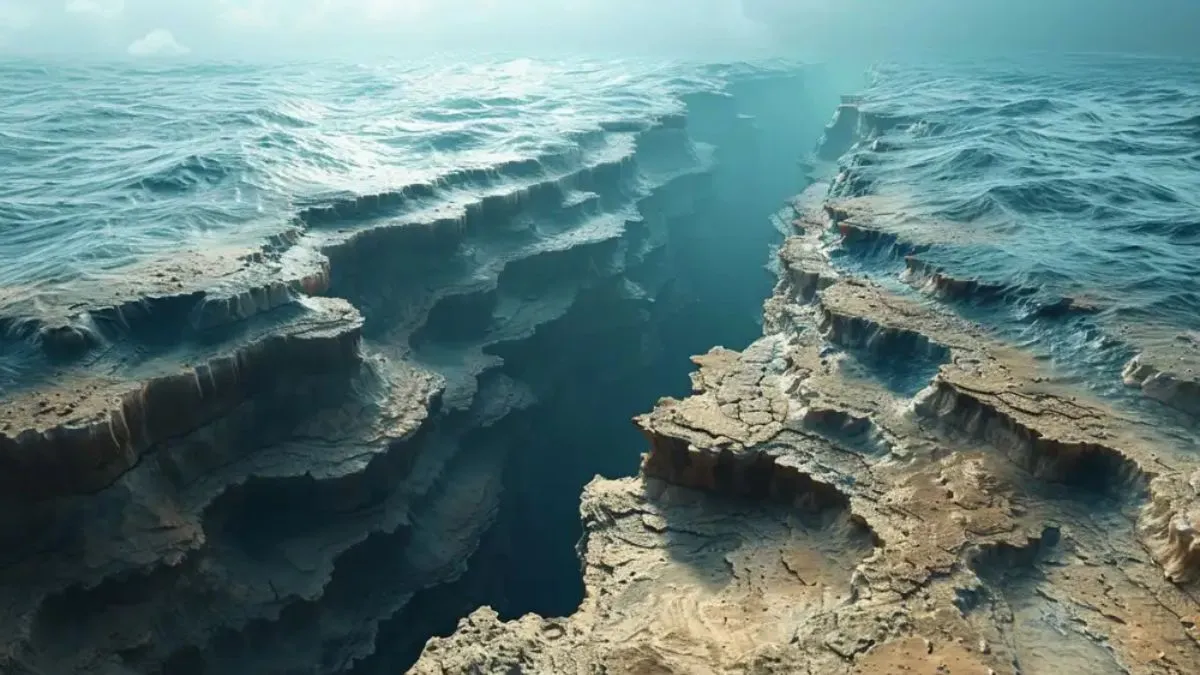
For the first time in history, an international team of scientists has recorded the fragmentation of a tectonic plate under the ocean floor.
The phenomenon was observed off the coast of Vancouver Island, Canada, in the Cascadia region, where the Juan de Fuca and Explorer plates are separating beneath the North American plate.
The discovery, published in the journal Science Advances, constitutes an unprecedented image of the beginning of the end of a subduction zone, areas where one plate sinks beneath another, generating volcanoes and earthquakes.
An Unprecedented Image of Tectonic Rupture
“This is the first time we have a clear image of a subduction zone on the brink of extinction,” stated Brandon Shuck, a geologist at the Louisiana State University and lead author of the study.
To record the phenomenon, the researchers used the ship Marcus G. Langseth, which sent sound waves toward the seabed. The echoes were captured by a 15-kilometer submarine cable, revealing the complex structure beneath the ocean floor.
The method, known as seismic reflection, works like an ultrasound: the waves penetrate the subsurface and return, allowing detailed images of the Earth’s crust’s internal layers to be created.
The results showed faults and cracks of tens of kilometers, evidence that the fragmentation began about 4 million years ago.
Cascadia: A Vulnerable Region
Experts confirm that the Cascadia subduction zone is undergoing a progressive rupture process. With each detachment, the Earth’s surface is reshaped, and pathways open where the hot mantle rises, fueling volcanic activity.
Researchers are analyzing whether earthquakes could exacerbate these fissures or if the newly discovered faults influence the propagation of seismic ruptures. Although the finding does not change the immediate risk, it will improve earthquake and tsunami prediction models in one of the most vulnerable regions on the planet.
Tectonic Plates: Engines of Life on Earth
The movement of tectonic plates is essential for the planet’s habitability. Their functions range from climate regulation to the creation of landforms and natural resources.
Importance for Climate and Habitability
- Climate regulation: volcanism releases carbon dioxide, maintaining temperatures suitable for life.
- Carbon cycle: oceanic sediments return to the atmosphere through volcanism, ensuring the continuity of life for millions of years.
Creation of Landforms and Resources
- Mountain formation: result of plate collision at convergent boundaries.
- Formation of continents and supercontinents: shaped by millions of years of tectonic movement.
- Mineral deposits: exposed and hidden by the dynamism of the plates.
- Hydrothermal vents: underwater vents that host unique ecosystems and may have been key to the origin of life.
Geological Phenomena
- Earthquakes: occur at plate boundaries when they collide, separate, or slide past each other.
- Volcanism: directly linked to tectonic movement and magma release.
- Ocean trenches: like the Mariana Trench, formed when one plate sinks beneath another.
Understanding Earth’s Dynamics
The recording of tectonic fragmentation in Cascadia marks a milestone in modern geology. Understanding how plates separate is crucial for anticipating the impacts of these colossal forces on Earth’s future.
This finding not only enhances the ability to predict earthquakes and tsunamis but also reinforces the importance of tectonic plates as engines of life and the planet’s habitability.



