



Science took a decisive step by successfully extracting and analyzing RNA from a Tasmanian tiger, a species that went extinct in the 20th century. This advancement allows us to observe not only which genes it had, but also how they functioned.
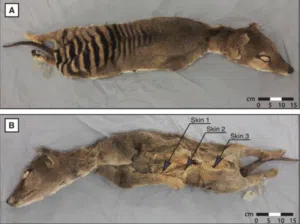
The study relies on a specimen preserved since the late 19th century, demonstrating that museums hold genetic information that is still active. Thus, the biology of the past speaks again.
Moreover, this achievement redefines the boundaries of environmental research, as it connects the loss of biodiversity with new tools to understand it in depth.
From DNA to RNA: a scientific revolution
Until now, the analysis of ancient DNA offered a static image of the genome. However, RNA provides a dynamic reading of cellular activity in specific tissues.
Due to its fragility, it was believed impossible to recover it after decades outside a living organism. Nonetheless, dry and stable conservation conditions allowed to halt its degradation.
Thanks to high-throughput sequencing techniques, it was possible to analyze millions of fragments and reconstruct the animal’s biological processes with remarkable precision.
What past tissues reveal
In the muscle tissue of the Tasmanian tiger, genes associated with contraction and efficient energy use were detected. This suggests an animal adapted to endurance and sustained movement.
In the skin, however, genes linked to keratin predominated, key for external protection. Traces of hemoglobin also appeared, indicating the state of the specimen when it was prepared.
These data confirm that the recovered RNA retains functional coherence, validating its usefulness for ecological and evolutionary studies.
Key information about the Tasmanian tiger
The Tasmanian tiger, or thylacine, was a carnivorous marsupial that inhabited Australia and Tasmania. It played a central ecological role as a top predator.
Its extinction was linked to intensive hunting and habitat alteration. The loss of this species caused imbalances in the local ecosystems.
Understanding its functional biology allows for a better assessment of the environmental impact of its disappearance and reinforces the importance of conserving today’s great ecological regulators.

Ecological implications and future research
The study significantly expanded the knowledge about thylacine microRNA, key in genetic regulation. This improves the quality of comparisons with living species.
Additionally, signals of ancient RNA viruses were identified, opening the possibility of studying viral evolution through historical specimens.
In a context of global environmental crisis, this new paleotranscriptomics offers tools to understand how the loss of species affects deep biological processes.
Museums, biodiversity, and a new scientific era
Natural history collections emerge as living archives of the past. In them, genetic information can help prevent future extinctions.
This advancement reinforces the need to protect both the current biodiversity and the scientific heritage. Thus, the Tasmanian tiger continues to teach, even from extinction.


