



Chimpanzees share much more with us than an evolutionary history. Their ability to communicate through sounds, gestures, and postures is a window to the past of human language. However, for a long time, it was not known whether these behaviors were learned or inherited.
A recent study in Uganda shed light on this issue. By monitoring wild chimpanzees, it was discovered that adult individuals imitate the communicative style of their mothers and other maternal relatives. This demonstrates that communication is also taught and socially transmitted.
Researchers analyzed 22 chimpanzees from Kibale National Park. Over 30 hours of observation, they recorded vocalizations, movements, and facial expressions. The result was clear: maternal bonds directly influence how they communicate.
Unlike fathers, the bonds with the mother and maternal siblings are essential. This is because the young grow under their protection and companionship for years, reinforcing social learning from very early stages.
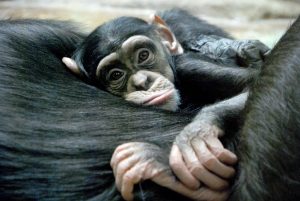 Chimpanzees learn to communicate by imitating their mothers.
Learning to Speak in the Jungle
The scientific team focused on chimpanzees over 10 years old. At that age, their ways of communicating are already consolidated and do not vary as much as in juveniles. Thanks to this, it was confirmed that the family environment is decisive.
Males tend to stay in the community where they were born. Females, on the other hand, migrate when they reach sexual maturity and raise their offspring alone. In this context, it is logical that communicative learning mainly occurs between mother and offspring.
Throughout their lives, a female can have between zero and five offspring that reach adulthood. Each of them will incorporate gestures, sounds, and behaviors observed in their immediate environment, reinforcing the family tradition of non-verbal language.
This positions social learning as a key element in understanding the evolution of human language. If chimpanzees inherit communicative behaviors from the maternal environment, it is likely that our ancestors did too.
Beyond Language: Amazing Behaviors of Chimpanzees
In addition to their way of communicating, chimpanzees exhibit behaviors that are surprising due to their complexity. They use tools, such as sticks to extract termites or stones to crack nuts. This ability to solve problems with objects is evidence of their intelligence.
They also show empathy and comfort towards their peers. In situations of conflict or distress, it is common for them to hug or caress each other as a way to calm each other down. These actions strengthen bonds within the group.
Moreover, they form political alliances. Males can strategically associate to climb positions within the social hierarchy. This ability to weave relationships for specific purposes is rare among other animal species and reflects a high level of social awareness.
 Chimpanzees.
Nature and Behavior: a Teaching Bond
Studies like this not only help understand how language evolved but also reinforce the need to conserve the natural habitats where these species live because the environment is a fundamental part of their social and cultural development.
Kibale National Park, where the research was conducted, is a key space for the protection of primates. It harbors a great biodiversity and is considered a natural laboratory to study our closest relatives without altering their way of life.
Preserving their habitat is not just an ecological issue but also a cultural one. Every gesture and every sound that chimpanzees learn is an expression of their world.


