



A team from the University of Cádiz detected microplastics on the coasts of Deception Island. Thus, the discovery challenges the idea of a completely pristine environment.
Indeed, the recorded concentrations ranged between 2 and 31 particles per kilogram of sand. Consequently, the finding confirms that pollution reaches even the most isolated corners of the planet.
Additionally, the majority of the waste consists of degraded fragments of larger plastics. This suggests prolonged processes of environmental wear and transport from other regions.

Scientific evidence and expansion of the problem
The samples were collected on ten beaches distributed across the island during 2023. At each site, researchers extracted surface sediments in the high tide zone.
Subsequently, in the laboratory, they applied flotation techniques with hypersaline water. In this way, they managed to separate plastic particles from the sand with precision.
On the other hand, studies by the International Atomic Energy Agency confirmed the presence of microplastics in water, sediments, mollusks, and penguin feces.
Among the identified materials are polymers such as PTFE, PVC, polypropylene, and PET. Consequently, there is evidence of widespread contamination at different levels of the ecosystem.
Environmental impact and global alert
Historically, Antarctica was considered a natural laboratory for climate change. However, it now also reflects the expansion of plastic pollution.
In this context, the presence of microplastics in living organisms raises concern. These residues can enter the food chain and alter key biological processes.
Therefore, the finding reopens the debate on the effectiveness of global policies. The evidence indicates that ocean currents and atmospheric transport distribute pollutants on a planetary scale.
Furthermore, specialists warn that this phenomenon demands stricter international agreements. The protection of remote ecosystems depends on coordinated actions.
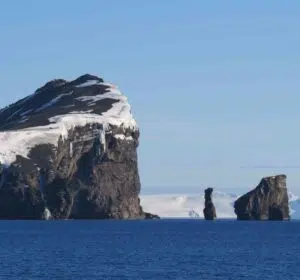
Environmental conditions of Deception Island
Deception Island presents unique characteristics within Antarctica. It is a flooded volcanic crater, creating a unique landscape of dark beaches and geothermal activity.
Additionally, the temperatures are extremely low, although certain areas show relatively warm waters due to volcanic influence. This creates particular microhabitats.
On the other hand, strong winds and ocean currents influence sediment dynamics. Consequently, these factors facilitate both the accumulation and dispersion of contaminant particles.
Furthermore, the biodiversity includes seabirds, seals, and penguin colonies. However, the fragility of the ecosystem makes it highly vulnerable to external impacts.
Science, monitoring, and future challenges
The advancement of these investigations allows for the dimensioning of a growing problem. As studies expand, the presence of microplastics is detected in more components of the environment.
In this sense, Antarctica ceases to be seen as an untouched refuge. On the contrary, it becomes an early indicator of the extent of global pollution.
Finally, the challenge lies in strengthening monitoring and reducing waste production. Only then will it be possible to preserve these key ecosystems for the planet’s environmental balance.



