



Once again, Mount Etna showed its fury. The recent eruption of Europe’s most active volcano filled the Sicilian sky with smoke and ash. But while the lava advances on the surface, a new line of research proposes looking in another direction: trees.
An alliance between NASA and the Smithsonian Institute discovered that vegetation near volcanoes can reveal early signs of volcanic activity. How? Through a sudden “greening” that occurs when trees absorb carbon dioxide released by rising magma.
This change, invisible to the human eye in many cases, can be observed from space. Satellites like Landsat 8 detect subtle variations in foliage coloration, which could be used as early alerts of a possible eruption.
The problem with volcanic gases is that the most dangerous ones, like carbon dioxide, are difficult to measure directly and are released before other more visible compounds like sulfur. That’s why the behavior of flora could become an ecological monitoring tool for volcanic activity.

A Green Signal Amidst the Risk
The study is still in the experimental phase, but it’s already being tested on volcanoes surrounded by jungle in Panama and Costa Rica. In these cases, trees act as natural sensors, responding to the increased CO₂ with accelerated leaf mass growth. This change can be tracked by satellite, even in remote or hard-to-reach areas.
The finding opens a novel surveillance avenue: using ecosystems to anticipate geological events. It’s an interdisciplinary approach where ecology and vulcanology work together to protect vulnerable communities.
However, there are limitations. Not all volcanoes are surrounded by dense vegetation, and tree types vary in their response to the gas. In arid or high mountain areas, this strategy loses effectiveness, requiring it to be combined with other monitoring technologies.
Worldwide, one in ten people live near an active volcano. And while eruptions cannot be avoided, any early signal is vital. Nature, once again, could be giving us the key: trees could become the new green guardians of the Earth.
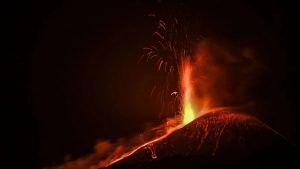
The Background of Mount Etna
Mount Etna, located on the island of Sicily, Italy, is one of the most active and well-known volcanoes in the world. Its eruptive history dates back over 500,000 years, and since then, it has had hundreds of eruptions, some of them devastating. Etna was fundamental in the geological formation of the region, influencing the landscape and Sicilian culture.
In ancient times, the volcano was considered a sacred place by the peoples of the region, such as the Greeks, who associated it with the god Hephaestus, the god of fire and metallurgy. The first documented observations of its eruptions date back to the 6th century BC, demonstrating its prolonged activity throughout history.
Throughout the centuries, Etna left a significant mark both in science and in nearby communities. The most recent eruptions have been intense, but thanks to advances in vulcanological studies, there is now constant monitoring that allows for better prediction and management of the risks associated with the volcano. Despite its constant activity, Etna remains a source of scientific and touristic fascination.


