



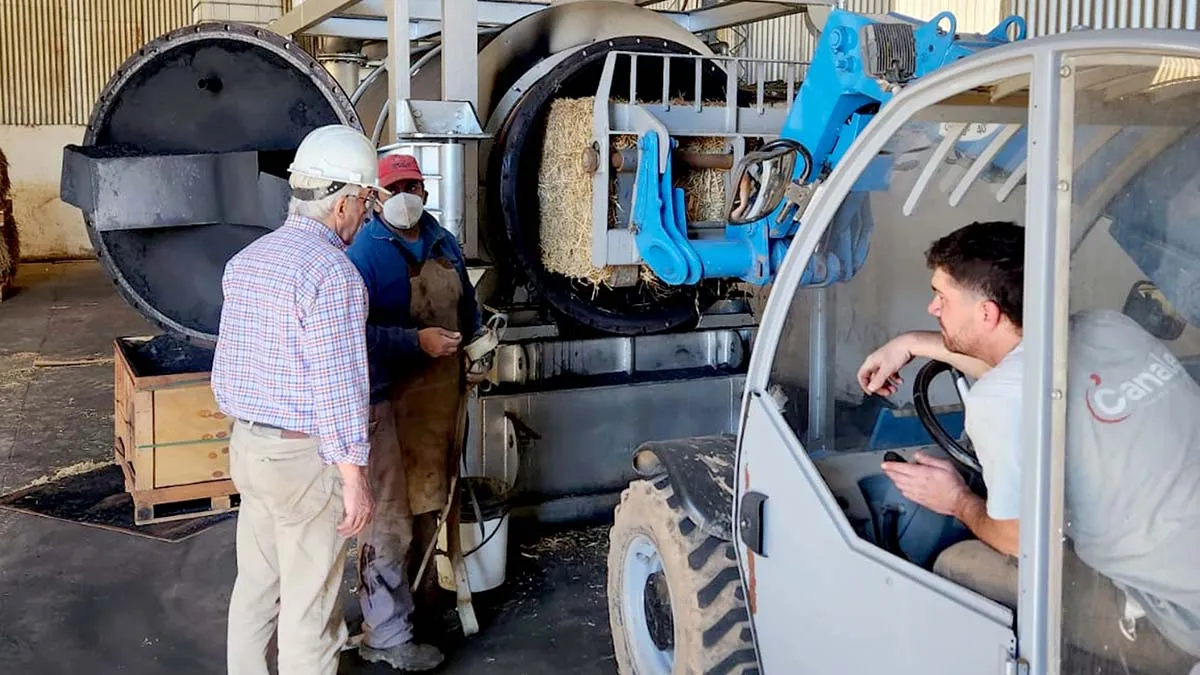
The National University of Río Cuarto (UNRC) leads a scientific-technological development aimed at transforming waste into sustainable solutions. In collaboration with the company Canale SRL, the institution became the first university in the country to produce biochar from rice straw, through a biomass pyrolysis process entirely designed in its laboratories.
This advancement constitutes a concrete contribution to the valorization of agro-industrial waste and the generation of environmental solutions with a scientific and technological basis.
The problem of rice straw
The project arises from a demand in the province of Corrientes, where the so-called “rice straw” represents a waste of difficult management and an environmental problem.
The development is framed within the research lines of the Institute for Agroindustrial and Health Development (IDAS), a dual dependency of UNRC–CONICET.
What is biochar?
Dr. Leonardo Molisani, a member of the IDAS GAV research team, explains that biochar is a vegetable charcoal obtained by pyrolysis, a thermochemical process in the absence of oxygen. This method allows transforming waste that was previously a problem into value-added materials, especially useful in the agricultural field.
Biochar applied to the soil improves its fertility, increases organic carbon, and contributes to the circular economy, closing production cycles and reducing environmental impacts.
Environmental importance
The production of ecological charcoal offers multiple benefits:
- Climate change mitigation: the CO₂ released is part of the natural carbon cycle, avoiding methane emissions from waste decomposition.
- Reduction of deforestation: by using prunings and fast-growing biomass, the felling of primary trees is reduced.
- Improvement of soil health: increases fertility and supports biodiversity.
Social and economic benefits
- Rural development: promotes local economies with jobs linked to decentralized processing.
- Public health: generates less smoke than other fuels, reducing respiratory problems.
- Clean energy: offers a more efficient source for cooking and heating, with fewer harmful particles.
Sustainability and future
Ecological charcoal is a renewable resource if managed responsibly, ensuring a constant supply through sustainable forestry practices. Additionally, it drives the circular economy by reusing wood waste and agricultural residues that previously lacked value.
The development of biochar by the UNRC marks a milestone in the transition towards a more sustainable future. By transforming waste into resources, deforestation is reduced, emissions are mitigated, and social and economic benefits are generated. Ecological charcoal positions itself as a key alternative to mineral coal, with less environmental impact and greater contribution to the resilience of ecosystems and communities.



