



Each season, the trail “La Huella” invites you to discover the green heart of the deep Chaco. This 12-kilometer route follows the course of the Bermejito River, surrounded by dense native vegetation and inhabited by a rich wildlife. Tapirs, peccaries, and colorful birds often cross your path, turning every step into a unique experience.
During the recent trekking season opening, visitors from Buenos Aires and Chaco experienced this immersion guided by Dante Cabana, a connoisseur of the Chaco forest born in Paraje La Armonía. His connection with the land translates into stories that enrich the walk and arouse curiosity about the surroundings.
Dante, along with four other local guides, was trained in hiking, kayaking, and first aid. All of them have been trained by technicians from National Parks and the Rewilding Argentina Foundation. Their work is key for tourism to develop without negatively impacting the ecosystem.
Cabana lived in Buenos Aires for eleven years before returning to his homeland. Since 2012, he has been guiding those who visit the park with respect and wonder. He ensures that he has no plans to leave again, and that more and more people are choosing El Impenetrable to connect with nature consciously.
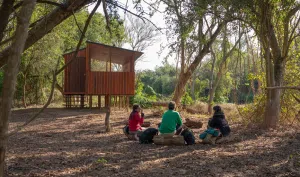 The trail “La Huella”, within El Impenetrable in Chaco, offers places to rest without affecting the environment. Photo: El Impenetrable.
Responsible Tourism with a Chaco Twist
The main activity is hiking, with walks of up to 15 kilometers, lasting between four and a half to five hours. They can only be done with authorized guides, available for hire at the La Armonía School Workshop, ensuring a safe and regulated experience.
The circuit is complemented by accommodation at the Carayá refuge, designed to observe wildlife without altering their routines. It is also possible to stay at the “San Nicolás Inn,” on the other side of the river, where local hospitality is expressed through traditional cuisine.
The adventure does not end with rest: the next day, visitors return by kayak, paddling for five hours along the calm Bermejito. During the journey, stops are made to eat, hydrate, and enjoy the landscape, strengthening the bond with the natural environment.
This type of activity promotes a model of ecotourism that protects biodiversity, generates employment for local communities, and offers visitors a transformative experience. Those who participate return with a new perception of the Chaco forest and its ecological richness.
Living Nature: The Value of El Impenetrable National Park
Established in 2014, El El Impenetrable National Park is the largest protected area in northern Argentina, with 128 thousand hectares of biological diversity. Among quebracho, algarrobo, and palo santo forests, there are wetlands, lagoons, and savannas.
Within it live endangered species such as the giant anteater, the armadillo, the tapir, the maned wolf, and the elusive jaguar. Their conservation is a priority, and the park serves as a safe haven for these iconic species of the Gran Chaco.
The joint effort of environmental organizations, local communities, and public institutions has transformed this area, previously used for extensive livestock farming, into a sanctuary for wildlife. Today, it represents an emblem of ecological restoration and sustainable development in the region.
 El Impenetrable offers an experience that allows you to know the forest and the river in its most natural environment. Photo: El Impenetrable.
More Ways to Experience Ecotourism in Argentina
In addition to El Impenetrable, there are many other options to enjoy nature without harming it. In Patagonia, self-guided trails and responsible navigation on the lakes of Los Alerces National Park allow you to admire ancient forests and glaciers.
In the Littoral region, the Esteros del Iberá offer photographic safaris, bird watching, and interpretive walks in areas restored by rewilding projects. In the NOA region, indigenous communities organize cultural tours with an ecological focus and respect for the territory.
Ecotourism continues to grow as an alternative to traditional forms of travel. Its success depends on a balance between conservation, environmental education, and local participation. Experiences like those in El Impenetrable are proof that it is possible to travel while taking care of what is visited.


