



Every year, between May and December, hundreds of **[southern right whales](https://noticiasambientales.com/ciencia/el-programa-ballena-franca-austral-cumple-55-anos-una-investigacion-sin-precedentes-en-la-conservacion-marina/)** (*Eubalaena australis*) return to the warm and protected waters of **[Puerto Madryn](https://noticiasambientales.com/ciencia/el-programa-ballena-franca-austral-cumple-55-anos-una-investigacion-sin-precedentes-en-la-conservacion-marina/)** and **[Península Valdés](https://noticiasambientales.com/ciencia/el-programa-ballena-franca-austral-cumple-55-anos-una-investigacion-sin-precedentes-en-la-conservacion-marina/)**.
Both sites in the province of Chubut are part of this **natural phenomenon** that makes the region one of the world’s most important destinations for **[whale watching](https://noticiasambientales.com/ciencia/el-programa-ballena-franca-austral-cumple-55-anos-una-investigacion-sin-precedentes-en-la-conservacion-marina/)**.
Moreover, they are a key epicenter for the **conservation of this species**.
## Why do southern right whales choose the Patagonian coast?
The **[southern right whales](https://noticiasambientales.com/ciencia/como-esta-la-salud-de-las-ballenas-de-peninsula-valdes/)** travel thousands of kilometers from the cold waters of the **South Atlantic** to the Argentine coasts to fulfill a vital cycle. **[Reproduction, calving, and caring for their calves](https://noticiasambientales.com/ciencia/como-esta-la-salud-de-las-ballenas-de-peninsula-valdes/)**.
The calm and shallow waters of **Península Valdés offer an ideal environment** for this crucial stage of their lives.
This migratory behavior is not random but based on a strong **biological memory and evolutionary adaptation**. This allows them to return each year to the same breeding sites.

Especially, females are **highly faithful to these areas** where they were born or reproduced previously.
## Puerto Madryn, the whale watching capital of Argentina
The return of the whales turns **[Puerto Madryn](https://noticiasambientales.com/ciencia/el-programa-ballena-franca-austral-cumple-55-anos-una-investigacion-sin-precedentes-en-la-conservacion-marina/)** into a tourist and scientific hub. Every year, thousands of visitors come to witness the natural spectacle offered by these cetaceans.
**Nature tourism**, especially responsible whale watching, has become a key tool to **educate and raise awareness** about the importance of protecting marine ecosystems.
Institutions like the **[Whale Conservation Institute (ICB)](https://noticiasambientales.com/ciencia/el-programa-ballena-franca-austral-cumple-55-anos-una-investigacion-sin-precedentes-en-la-conservacion-marina/)** and local organizations **monitor the behavior of these animals**, analyze their health, and study the effects of climate change and human activity on their habitat.
## Conservation of southern right whales: an urgent task
Although the population of southern right whales **[showed signs of recovery](https://noticiasambientales.com/animales/premian-al-programa-de-investigacion-ballena-franca-austral/)** since **commercial hunting was banned**, the species still faces multiple threats.
Among them are **entanglements in fishing nets**, **collisions with vessels**, **underwater noise**, and **climate change**. This affects the availability of food in their feeding areas.
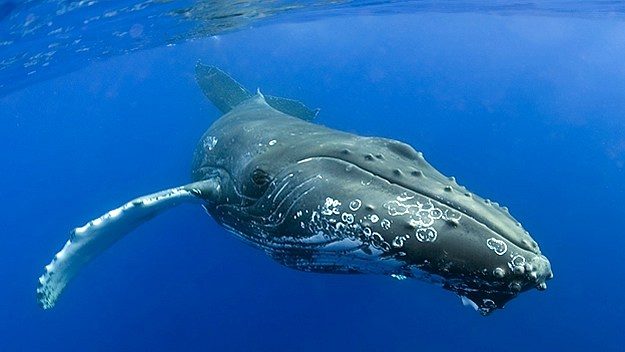
Therefore, **protecting breeding areas** like Península Valdés and regulating tourist and fishing activities are essential to ensure the **survival of the species**.
The majestic return of southern right whales to the Argentine coasts not only represents a **unique natural spectacle in the world** but also a call to strengthen commitment to **marine conservation** and **sustainable tourism**.
Preserving this natural cycle not only benefits the whales but also the communities dependent on **tourism, science, and all the biodiversity** of the **Argentine Sea**.



