



In a historic event for the conservation of native fauna, the giant otter returns to Argentina thanks to a family released in the Iberá Wetlands in Corrientes.
This marks the first reintroduction of this globally endangered species, which had been declared extinct in the country since 1986.
The group consists of four individuals, including two offspring born in semi-captivity in 2024.
Giant otter returns to Argentina: meet the individuals
The mother, Nima, comes from the Madrid Zoo (Spain) and the father, Coco, from Givskud Zoo (Denmark). Both were part of a complex readaptation process led by Rewilding Argentina in collaboration with national and international institutions.
 The reintroduction of the endangered species. (Photo: Rewilding Argentina).
With a length of up to 1.8 meters and a weight of up to 33 kilograms, the giant otter (Pteronura brasiliensis) is the largest aquatic mammal in the world.
Its ecological role is crucial as a top predator in wetlands, helping to maintain the balance of aquatic ecosystems thanks to its fish-based diet.
“The giant otter was a common presence in the Paraná basin, but disappeared due to human pressure. Its return is a decisive step to restore the ecological health of Iberá,” said Sebastián Di Martino, Director of Rewilding Argentina.
Iberá: an ideal sanctuary for reintroduction
With over 756,000 hectares of protected wetlands, Iberá Park gathers optimal conditions for reintroduction: abundant food, absence of human threats, and a vast area free from alterations.
This project not only aims to recover a locally extinct species, but also to revitalize its environment and create opportunities for sustainable tourism in Corrientes.
“The return of the giant otter is also an opportunity for local economies,” highlighted Gustavo Valdés, governor of Corrientes.
“More tourists will come to observe it, creating genuine job opportunities for communities. Corrientes consolidates itself as a leader in nature production and ecological restoration,” he added.
A pioneering project
The reintroduction program, started in 2017, included everything from the identification of breeding pairs to the design of health protocols, special enclosures, training in fishing with live fish, and the creation of post-release monitoring harnesses adapted to the species.
 The release of the otter family.
All this work makes this initiative a pioneering model globally.
In addition to Rewilding Argentina, the effort involves the National Parks Administration, the Ariranha Project from Brazil, the European Association of Zoos and Aquariums, and zoos from Hungary, Spain, Germany, Denmark, Sweden, France, and the United States.
“We are witnessing a real restoration of ecosystems. This species is reclaiming its ecological and symbolic role in the heart of the continent,” celebrated Kristine Tompkins, co-founder of Tompkins Conservation.
Next steps: more releases in Iberá and Chaco
The giant otter is considered endangered by the IUCN, and its wild population remains fragmented.
In this context, Rewilding Argentina plans new releases in the Esteros del Iberá and Chaco, aiming to restore ecological connectivity and consolidate stable populations.
“The giant otter not only returns to Argentina but also opens the door to a more ambitious ecological restoration, with direct benefits for the environment, nature tourism, and local communities,” Di Martino concluded.
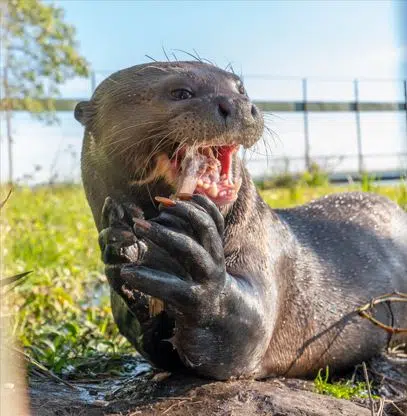 The appearance of the giant otter.
What is the Iberá Project
Located in the province of Corrientes, northeast Argentina, the Iberá Wetlands comprises the Iberá Provincial Park (600,000 hectares) and Iberá National Park (158,000 hectares).
The latter was created in 2018 thanks to donations from Tompkins Conservation and Rewilding Argentina to the Argentine government.
The wetlands are located in the center of a large subtropical plain surrounded by Paranaense Atlantic forest, Chaco forest, open grasslands, and thorny shrublands.
There, Rewilding Argentina is reintroducing 10 native species, including the jaguar, the main terrestrial predator, and the red macaw. This bird acts as a seed disperser for native vegetation, which is currently scarce.
The work of Rewilding Argentina is complemented by the promotion of a regenerative economy based on wildlife observation tourism, which in Iberá has become a main source of income for neighboring communities to the park and is an example of production-based conservation worldwide.



