



In January 2024, California, **United States**, was the scene of an alarming [episode](https://noticiasambientales.com/ciencia/eeuu-declarara-a-la-mariposa-monarca-como-una-especie-en-peligro/): hundreds of **monarch butterflies** were found dead or disoriented, showing signs of poisoning. Specimen analysis conducted by researchers revealed the presence of up to 15 **pesticides or their derivatives** in the ten specimens studied, with an average of seven substances per insect.
Among the contaminants found, three insecticides from the pyrethroid group, widely used in agriculture and gardening, stood out. In some cases, the detected concentrations were **potentially lethal**. The research also points to the cocktail effect, where the combination of several pesticides, even in low doses, can cause more severe damage than each substance separately.
This phenomenon is not isolated. Since the 1980s, **monarch populations** have decreased by between 80% and 95% in North America. The use of pesticides, combined with habitat loss and the impact of climate change, is pushing this migratory species into a critical situation.
Researchers indicate that **pesticide contamination** occurs even in **urban areas**, expanding the threat beyond **agricultural zones**. The proximity of these products to overwintering areas could be directly affecting the species’ survival.

### Conservation Status of the Monarch Butterfly
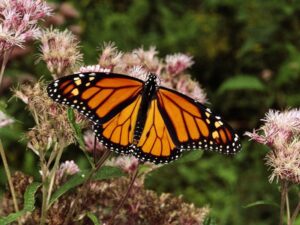
The **monarch butterfly** (*Danaus plexippus*) is famous for its annual massive migration from Canada and the United States to Mexico, a journey of thousands of kilometers that makes it a symbol of natural resilience. However, its **conservation status** is a cause for global concern.
On the **International Union for Conservation of Nature (IUCN) Red List**, the eastern migratory subpopulation is listed as **”Endangered”**, while the western one is **”Critically Endangered”**. The main threat is the loss of oyamel forests in Mexico, where it hibernates, due to **deforestation** and **land-use change**.
This situation is compounded by the reduction of milkweed in North America, an essential plant for its reproduction, which has been decimated by broad-spectrum herbicides. **Pesticides**, especially neurotoxic insecticides, **affect both larvae and adults**, compromising their ability to migrate and survive.
**Climate change** exacerbates the problem, altering temperature and precipitation patterns, disrupting the **migration calendar** and breeding areas. According to conservation organizations, the combination of these factors is jeopardizing one of the most impressive **natural phenomena** on the planet.
### A Call to Action to Save the Monarch Butterfly from Extinction
**Biodiversity and conservation specialists** urge the implementation of **urgent measures**: restricting the use of **pesticides near key habitats**, restoring host plants, and protecting overwintering forests. International collaboration is essential, as the monarch butterfly depends on three countries to complete its life cycle.
Without coordinated and effective actions, the iconic orange flight that crosses the skies of **America** could become just another memory of what humanity lost by not acting in time.


