



The massive expansion of sargassum in the Tropical Atlantic and the Caribbean has become one of the main environmental challenges in the region. Millions of tons of this floating macroalgae advance each year towards the coasts, altering marine ecosystems and generating economic impacts in numerous tourist destinations.
According to specialists dedicated to studying this phenomenon, since 2011 there has been a sustained growth of sargassum accumulations in the ocean. As a result, an extensive belt of algae has formed, almost 6,000 miles long between Africa and Brazil, from where ocean currents transport enormous volumes towards the Caribbean coasts.
Consequently, various scientific, environmental, and productive sectors agree that the issue requires comprehensive responses that combine prevention, monitoring, and sustainable utilization of this biomass.

A phenomenon driven by multiple environmental factors
Experts point out that the extraordinary growth of sargassum is related to a combination of factors that favor its accelerated reproduction in ocean waters.
On one hand, the input of nutrients from fertilizers used in agro-industrial activities in various Latin American countries increases the availability of compounds that stimulate algae development. These nutrients are transported by rivers and eventually reach the ocean.
On the other hand, the increase in sea surface temperature associated with climate change creates more favorable conditions for the proliferation of this species. In this way, global environmental changes contribute to intensifying a phenomenon that already affects numerous coastal countries.
The challenge of acting before it reaches the beaches
In this scenario, specialists argue that control actions must begin in the open sea, before the sargassum masses reach the coasts and cause greater ecological and economic impacts.
Additionally, in recent years, initiatives have been promoted to facilitate the collection and productive use of the biomass. In Mexico, a regulation issued in 2025 recognized sargassum as a fishery resource, allowing its capture and subsequent commercialization under a specific regulatory framework.
Furthermore, various actors promote the creation of markets that allow the use of the macroalgae as raw material for different industries. The goal is to generate demand that encourages investments aimed at its controlled extraction and sustainable management.
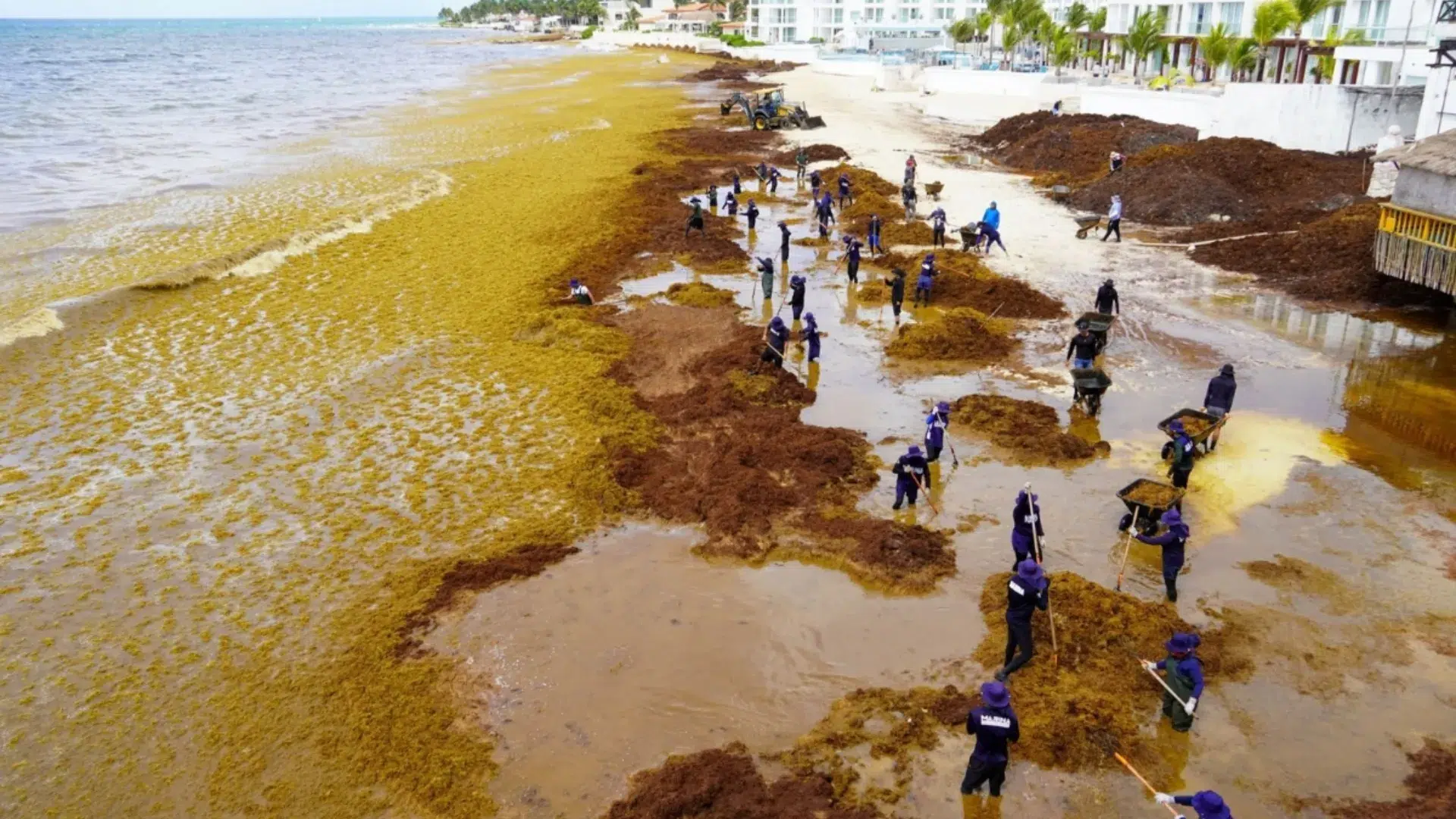
The environmental impact of sargassum on coastal ecosystems
Although sargassum fulfills important ecological functions when it remains in the open sea, massive arrivals can cause significant consequences in coastal environments.
When accumulating on beaches and shallow waters, the algae reduce the penetration of sunlight, affecting the development of seagrasses and coral reefs. These ecosystems constitute essential refuges for numerous marine species.
Additionally, during its decomposition, processes that decrease oxygen levels in the water are generated, and gases such as hydrogen sulfide are released, altering environmental quality and affecting aquatic organisms.
On the other hand, excessive accumulation can modify habitats used by sea turtles for nesting and by various coastal species for feeding and reproduction. This makes the phenomenon a growing concern for the conservation of regional biodiversity.
Riviera Maya and the search for sustainable solutions
In tourist destinations like Playa del Carmen and other points of the Riviera Maya, the arrivals recorded in recent years have generated concern due to their magnitude and frequency.
The authorities, entrepreneurs, and environmental organizations are analyzing different alternatives to minimize the impacts and strengthen the response capacity for future seasons of high algae concentration.
Meanwhile, the advance of sargassum highlights the need to address the root causes of the problem, from nutrient pollution to the effects of climate change. In this context, international cooperation and sustainable environmental management appear as fundamental tools to protect both the marine ecosystems and the coastal economies that depend on them.


