



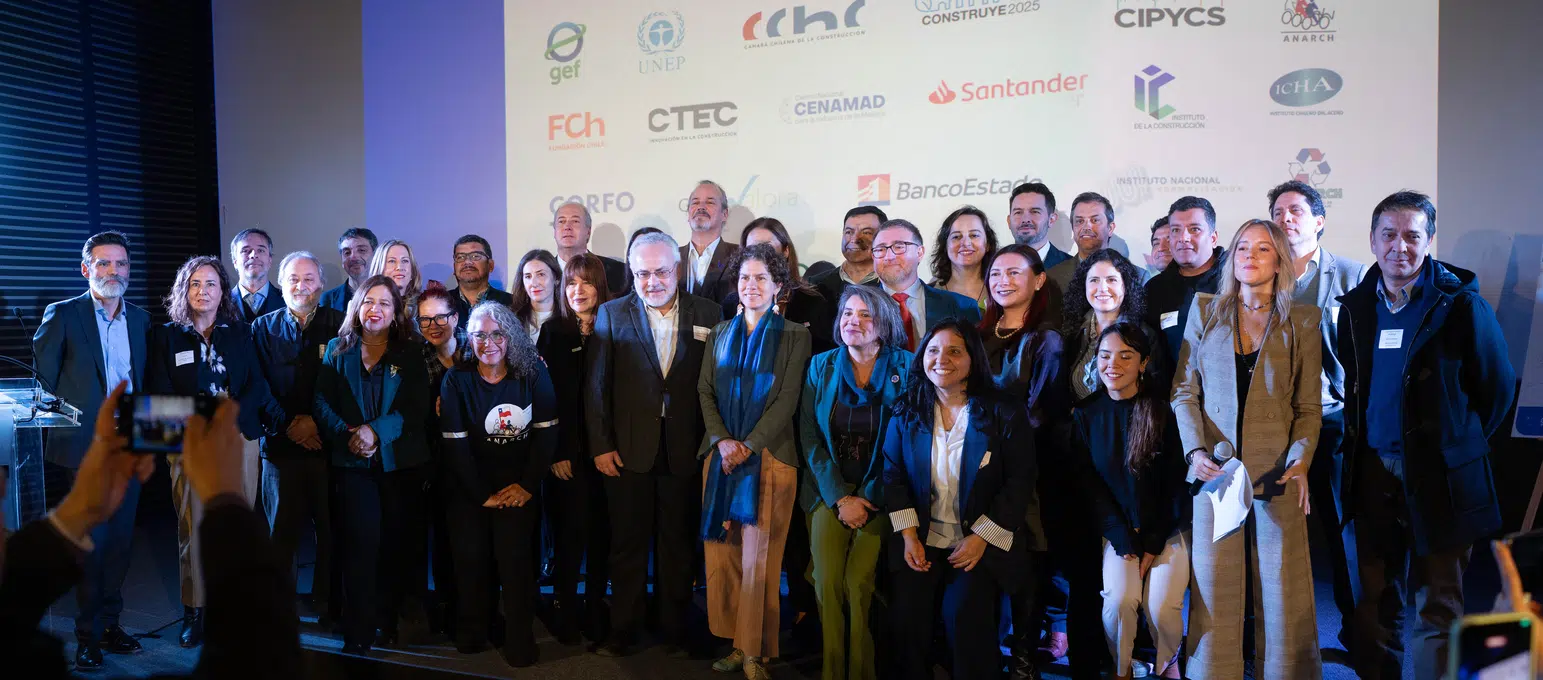
On August 12th, the project “Transitando hacia una construcción circular y descarbonizada en Chile” was officially presented. An initiative that seeks to redefine the national construction model through the circular economy, emission reduction, and efficient resource management.
The project is funded by the Global Environment Facility (GEF), coordinated by UNEP, and executed by Fundación Chile (FCh).
Collaborative governance: public-private articulation for structural change
The project involves key actors such as the ministries of Public Works (MOP), Housing and Urban Development (Minvu), Social Development and Family (MDSF). Besides entities like INE, INN, CORFO, SENAPRED, the Sustainability and Climate Change Agency, and representatives from the financial and business sectors, including the Chilean Chamber of Construction, ChileValora, BancoEstado, Banco Santander, and Ethical Banking.
“The transition from a linear model to a circular construction requires the commitment of the entire value chain,” emphasized the Ministry of the Environment.
Strategic objectives: resource efficiency and ecosystem regeneration
Minister Maisa Rojas highlighted that the project aims to mobilize the sector towards a comprehensive management of the materials life cycle, promoting:
- Design that prevents waste generation
- Reduction of natural resource use
- Regeneration of urban and rural ecosystems
This approach will align the industry with Chile’s climate commitments, generating positive impacts on the environmental, social, and economic aspects.
Concrete goals: emission reduction and waste valorization
According to Fundación Chile, the expectations are:
- Offsetting 350,000 tons of CO₂
- Valuing over 20 million tons of Construction and Demolition Waste (CDW)
- Avoiding waste in case of major seismic events
- Reducing over 20% of the country’s GHG emissions
Work axes: legal framework, financing, pilots, and open knowledge
A four-year plan with a $3 million international investment. The project includes five key components:
- Legal, regulatory framework, and quality infrastructure
- Financing and circular business models
- Territorial implementation
- Demonstration pilots
- Knowledge generation and management
Normative instruments, financial mechanisms, training platforms, and open tools will be developed, with a focus on gender and equitable access.
Technological pilots: innovation applied to circular construction
Technological partners are already advancing in the following pilots:
- CTEC: “Circular Solutions for Road Infrastructure”
- CENAMAD: “Certification for sustainable and circular forest and wood management”
- CIPYCS: “Certification for the regenerative wood production chain”
- InnovaCiclos: “Life cycle analysis and social price of environmental impacts in construction and demolition”
Strategic framework: alignment with climate commitments and national roadmaps
The initiative is based on instruments such as:
- CDW Circular Economy Roadmap 2035
- Long-Term Climate Strategy 2050
- Climate Change Framework Law, which makes sectoral goals binding
“Chile is moving towards regenerative, resilient, and low-emission construction, with a comprehensive vision that connects infrastructure, environment, and social well-being,” highlighted Juan Bello, regional director of UNEP.


