



Global warming, understood as the long-term increase in Earth’s average temperature -caused by human activities-, not only affects the climate, but also the species that inhabit the planet. One of the many affected is the shark, an animal that suffers from weak and fragile teeth, a consequence of ocean acidification.
An article published in Frontiers in Marine Science revealed that ocean acidification, caused by global warming, can damage the teeth of these species, becoming a serious problem. Although it is known that sharks are famous for their ability to replace their teeth, this would not be enough to ensure their survival.
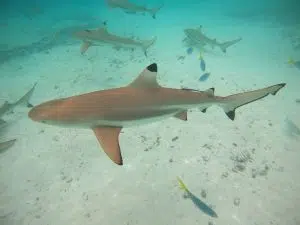
According to experts, blacktip sharks must swim with their mouths open to breathe, causing their teeth to remain exposed to the water, which can automatically damage them if the water is too acidic.
As the teeth are the major survival tool of this species, specialists ensure that it is important to maintain the pH of the ocean close to the current average of 8.1, as it would help maintain the physical integrity of the predators’ tools.
How the study was conducted
To reach this conclusion, researchers worked with two average ocean pH levels, the current of 8.1, and the one stipulated for the year 2300, 7.3; that is, 10 times more acidic than the current level. They also collected over 600 discarded teeth from a shark aquarium, which were used for the experiment.
Several of these teeth, 16 intact and 36 with some damage, were incubated for two weeks in separate 20-liter tanks to measure the circumference before and after. This showed that teeth exposed to more acidic water suffered much greater damage.
In these samples, they observed surface damage, such as cracks and holes, as well as increased root corrosion and structural degradation. Although sharks could remineralize or replace damaged teeth faster, the energy cost would likely be much higher in acidified water.

The amazing dentition of sharks
Sharks have one of the most efficient dentitions in the animal kingdom. Throughout their life, they are capable of producing thousands of teeth, as they do not have a single fixed set of teeth like humans, but rows that are constantly renewed.
When a tooth wears out or is lost during hunting, a new one emerges from the posterior row to replace it. This process can occur in a matter of days or weeks, ensuring that they always have their dentition ready to capture prey.
It is estimated that some species can produce between 20,000 and 30,000 teeth throughout their life. This regenerative capacity not only ensures their survival in the oceans but has also inspired scientific research in search of advances in regenerative dentistry.


