



For the first time, a **mammal in critical danger** was photographed in the wild emitting **natural biofluorescence**, a [biological phenomenon](https://noticiasambientales.com/medio-ambiente/el-increible-fenomeno-biologico-en-las-islas-malvinas-detectado-por-la-nasa/) that allows certain organisms to **reflect ultraviolet light**.
The discovery, made by photographer **Benjamin Aldridge**, marks an **unprecedented scientific breakthrough** and opens new lines of research on animal behavior, evolutionary adaptation, and [conservation of poorly documented species](https://noticiasambientales.com/animales/un-mega-relevamiento-con-camaras-trampa-revela-el-estado-de-los-mamiferos-de-la-region-chaquena-argentina/).
## The protagonist: the eastern quoll
The captured animal is the **eastern quoll (Dasyurus viverrinus)**, a **medium-sized carnivorous marsupial**, native to **Australia and Tasmania**.
Its fur, ranging from **light brown to black**, reflects ultraviolet light generating a natural **fluorescent effect**, similar to materials used in nightclubs, but completely **biological**.
Main characteristics of this critically endangered mammal:
– **Appearance**: compact body, fur with **white spots**, **pointed snout**, and **thick tail**
– **Habitat**: tropical forests, heathlands, and alpine areas; currently mainly found in **Tasmania**
– **Diet**: insects, small mammals, birds, and reptiles
– **Behavior**: **nocturnal**, rests in **burrows or nests** during the day
– **Conservation status**: extinct on the Australian mainland; in the process of **reintroduction in protected sanctuaries**
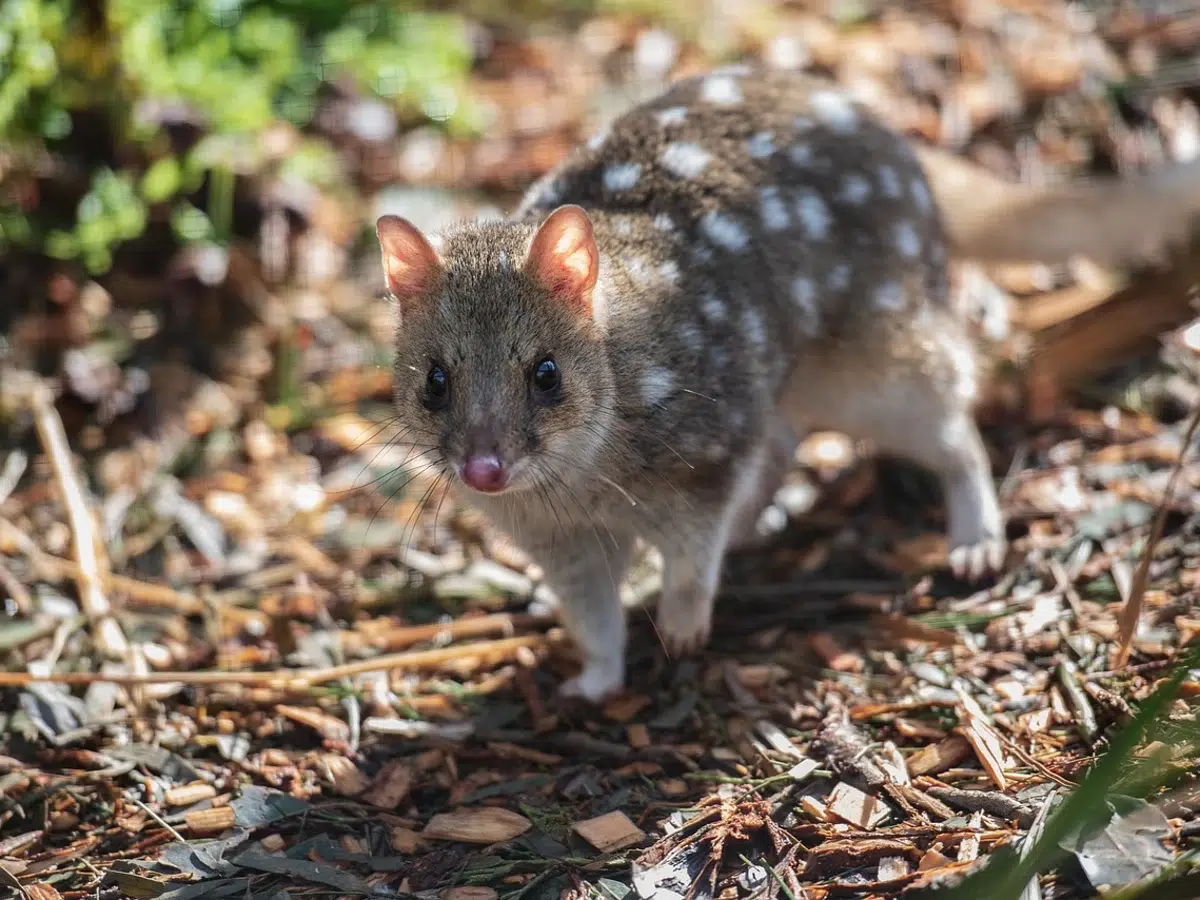
*The eastern quoll, a critically endangered mammal*
## Scientific relevance of the discovery
**First evidence of biofluorescence in a living marsupial.**
This record represents:
– The **first documented case** of **biofluorescence in a living marsupial**
– An opportunity to study how these species **interact with their nocturnal environment**
– New questions about **communication, camouflage, and evolution** in wild ecosystems
## Scientific photography as a conservation tool
The image was selected among the best of the **Beaker Street Competition**.
Aldridge’s photograph was chosen among the **12 best images** of the **Beaker Street Scientific Photography Competition**, and will be exhibited in the **Art Gallery of the Tasmanian Museum** during August.
Specialist **Margo Adler** highlights that these images **bring science closer to the public** and reveal aspects that normally **remain hidden**.
Exhibition objectives:
– Show the **diversity of Australian wildlife**
– Raise awareness about **critically endangered species**
– Highlight the impact of **light pollution** on the nocturnal life of mammals
## Implications for conservation and environmental education
A phenomenon that inspires new scientific and pedagogical strategies.
Experts point out that **biofluorescence** could have functions in **communication between individuals**, **nighttime camouflage**, or **prey detection**, although these aspects are still under study.
Additionally, the photograph:
– Reinforces the need to **protect native habitats**
– Allows studying the **interaction between species and artificial light**
– Inspires **educational strategies** to bring biology closer to the general public
*Cover photo: Benjamin Aldridge*


