



Thanks to a high-precision laser used by the Geodetic Observatory of the Technical University of Munich (TUM), it managed to measure how it wobbles in its displacement through space. With this unique tool, the experts were able to collect data 100 times more precise than gyroscopes or other ring lasers.
According to the experts, this precise measurement helps better understand and model the Earth’s system. As of now, it is known that the Earth’s axis is not firmly anchored in the sky, but various forces act upon it, generating oscillations of different intensities.
They also add that the most significant influence comes from the imperfect and round shape of the Earth, which bulges slightly at the equator. This effect is known as precession, responsible for causing the extension of the Earth’s axis, marking a circle in the sky.
Currently, the Earth remains precisely aligned with the Pole Star, but it is believed that in the future it will align with other stars before returning to it, leading to a 26,000-year cycle.
The Sun and the Moon also influence
Some of the forces acting on the planet are the Moon and the Sun, which sometimes reinforce or weaken each other while exerting pressure on the Earth’s axis. This effect is known as nutation, causing small undulatory movements in the precession circle of the axis.
In fact, there is a specific nutation of 18.6 years, but also other smaller ones with weekly or daily changes. Therefore, this would be an example that the axis does not oscillate uniformly, but with different degrees of intensity.
A tool with great precision
To reach this conclusion, the ring laser measured all the effects of the influencing forces directly for 250 days with high-precision sensors that operate independently of external signals. This means it does not need a large network of radio telescopes distributed across different continents.
In addition to its relatively small size, it has a temporal resolution of fluctuations less than an hour instead of a day, and the results are immediate, unlike radio telescopes that take days or weeks to provide the collected data.

Characteristics of the ring laser
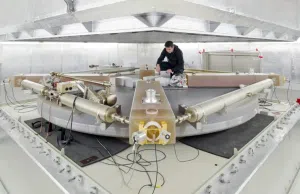
The ring laser of the Technical University of Munich is one of the most precise in the world and is used to measure the Earth’s rotation with very high accuracy. It operates through a physical principle known as the Sagnac effect, which allows detecting minimal variations in the movement of Earth through light interference.
This device has a square shape and is composed of a closed circuit of large mirrors. Inside the ring, laser beams travel in opposite directions, and when compared, any difference in the path reveals imperceptible changes in the rotation or Earth’s orientation.
Thanks to this technology, the ring laser allows recording phenomena such as microvariations in the speed of planet rotation, seismic movements, or even displacements related to climate and ocean levels. Its applications are fundamental for geodesy, fundamental physics, and large-scale environmental monitoring.


