



The story of the Patagonian seahorse, or Hippocampus patagonicus, the only native species of its kind along the Argentinian coasts, is one of perseverance and curiosity.
Its discovery took place just about 20 years ago, and between 2005 and 2019, an 80% reduction in population was detected. Although the decrease in tourism and fishing activity during the pandemic brought temporary relief, now the “threats” have reappeared and its survival is a cause for concern.
From doctoral thesis to the discovery of a new species
The discoverer, biologist Diego Luzzatto, had his first encounter with these enigmatic fish not in the sea, but on a train.
In the early 90s, at the San Antonio Oeste station, some vendors were selling dried souvenirs, including seahorses. Unbeknownst to him, that casual sighting in his adolescence would mark the beginning of a groundbreaking research.
Years later, in 2002, Luzzatto was working on his doctoral thesis in Mar del Plata. It was then that his colleague Gabriela Piacentino, a researcher at the Argentine Museum of Natural Sciences, made an intriguing revelation to him.
 The story of the Patagonian seahorse. (Photo: Wikipedia).
“Nothing is known about them in Argentina,” he thought. The lack of information prompted Piacentino to ask Luzzatto to collect any seahorse specimens he found during his trips to the sea.
With a few attempts, the first ones appeared. After analyzing and comparing them with museum collections, the pair of researchers reached an astonishing conclusion. It was a seahorse species not described by science.
The birth of Hippocampus patagonicus
Recalling his teenage encounter in Patagonia, Luzzatto traveled back to the coasts of San Antonio Oeste in search of more evidence, as the story is recounted in the publication Aristegui Noticias.
After two years of rigorous studies and DNA analysis, in 2004, the researchers formalized the description of the new species, naming it Hippocampus patagonicus.
This discovery not only filled a gap in scientific knowledge but also laid the foundation for the research and conservation work of this unique fish. It is mainly found in the waters of Mar del Plata and San Antonio Oeste.
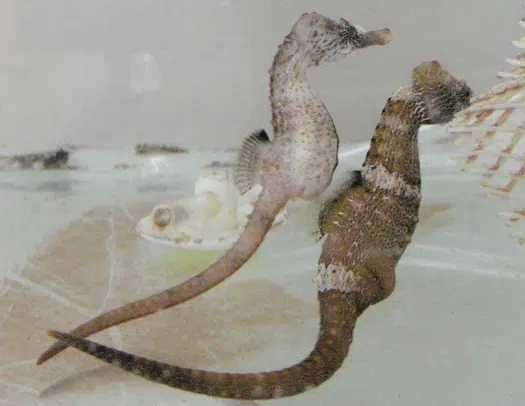 What the Patagonian seahorse looks like. (Photo: Wikipedia).
Unlike other fish, this seahorse has no scales; its body is protected by rigid plates that limit its movements, a distinctive feature of its family.
Another peculiarity is that the length of its snout represents on average a proportion of 2.96 with respect to the total length of the head.
This discovery is a reminder of how curiosity can lead to great scientific findings and the importance of local research for the conservation of marine biodiversity.



