



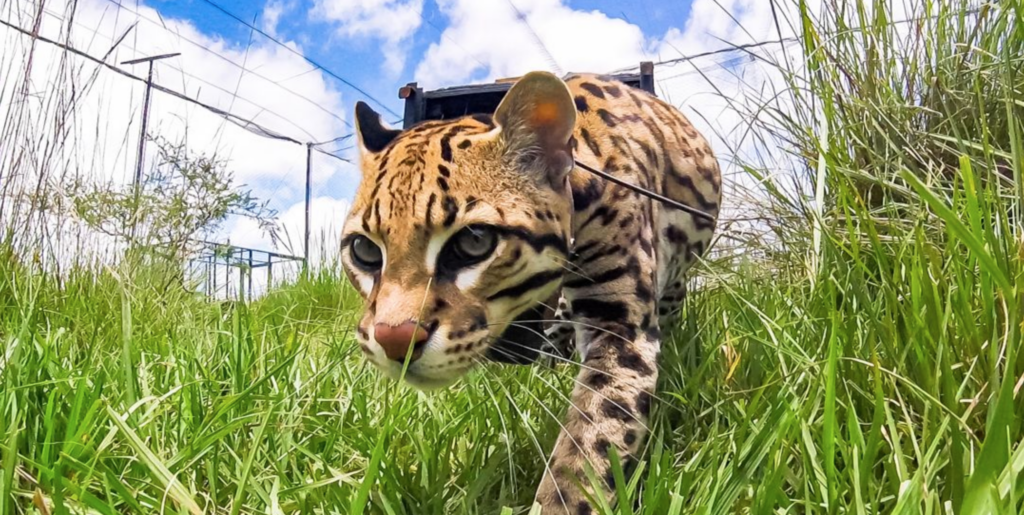
The ocelot is one of the most fascinating felines in the Misiones jungle. However, its elusive nature has kept it as an enigma for science for decades.
But now, an unprecedented study by CONICET sheds light on the dynamics of ocelots in Misiones. This is the largest analysis ever conducted on the species worldwide.
The monitoring allowed the identification of more than 200 individuals and tracking them for 14 years. This was carried out in a protected area of over a thousand square kilometers covering the Iguazú National Park and the San Jorge Forest Reserve in the province of Misiones.
And the results bring good news: in well-preserved environments, the species appears to be stable. It shows an annual growth rate of 1.0, indicating that, although the specimens do not increase, they do not decrease either.
This is particularly relevant because ocelots are among the felines most sensitive to the impact of human activity.
Furthermore, it also means that the ecosystem within these protected areas is healthy, resilient, and self-sustaining. It is capable of supporting its top predators without human intervention.
What else does the study analyzing the population of this feline, crucial for the health of ecosystems, tell us?

First surprise: ocelots in Misiones live almost twice as long as estimated
One of the most striking discoveries is that ocelots live much longer than science imagined.
The study by CONICET, led by Paula Cruz from the Institute of Subtropical Biology (IBS, CONICET-UNaM), recorded the oldest specimens ever documented in nature.
Researchers identified a female of at least 19 years and a 12-year-old male. These figures set aside the previous estimate that ocelots lived between 10 and 11 years in the wild.
But the most revealing finding was another female who, at 16 years old, was photographed nursing a small cub.
This extraordinary detail not only demonstrates exceptional longevity, but also confirms that the habitat is so healthy and resource-rich that it allows females to successfully reproduce at a very advanced age.

Ocelots, essential for the health of the Misiones Jungle
Beyond their own value, the ocelot is a key indicator of the health of well preserved native forests.
Since it is an extremely sensitive species to human impacts, it quickly disappears as soon as the jungle is fragmented, deforestation progresses, or illegal hunting intensifies.
Therefore, a robust and stable ocelot population is the best health certificate an ecosystem can have.
As Cruz explains, the species plays a fundamental role in anticipating major problems: “For a system to be healthy, it is necessary to have the presence of ocelots. They play a fundamental role in a Misiones ecosystem.”
That’s why “studying this species that is so sensitive to changes allows us to anticipate and prevent the loss of other species in those environments.”
Ocelot males and females behave differently, according to CONICET
The CONICET study of the ocelot population in Misiones provided many interesting data to analyze. Among them are the differences in behavior between females and males.
Scientists detected very different roles between male and female ocelots in the Misiones jungle.
In general, males are great explorers. They constantly move through much larger activity areas in search of mating opportunities and resources.
Females, on the other hand, proved to be


