



Park rangers from the Provincial Atlantic Coast Reserve in Tierra del Fuego detected the stranding of a group of orcas in San Sebastián Bay, within a highly ecologically sensitive protected area. The discovery, made during routine monitoring tasks, raised alarms among specialists and environmental authorities.
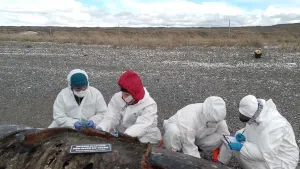
The Secretariat of Environment and the General Directorate of Biodiversity and Conservation immediately activated the emergency protocol, notifying the scientific team from CADIC-CONICET, which is working on sample collection to determine the causes of the event. Initial analyses suggest it could be a natural phenomenon, although other environmental or anthropogenic factors are not ruled out.
Orcas (Orcinus orca) are apex predators and one of the most important biological indicators of marine balance. In the southernmost part of the continent, they are usually observed during spring and summer, attracted by the abundance of fish, sea lions, and other species that make up their diet.
This episode occurs in one of the most fragile areas of the South Atlantic, where fishing activity, maritime transport, and the effects of climate change converge. The presence of stranded orcas is a warning about the vulnerability of southern ecosystems.
Ecosystem at risk: signals from the southern ocean
Cetacean strandings can have multiple causes, and their analysis provides key information about the ocean’s environmental health. Factors such as acoustic pollution, changes in ocean currents, prey depletion, or the presence of toxic substances can alter the behavior of these highly sensitive animals.
Among the most common hypotheses is the sound interference produced by vessels, radars, and sonars, which can disorient cetaceans by affecting their echolocation system. In social species like orcas, the disorientation of a single individual can lead the entire group to shallow waters or beaches.
Another determining factor is the abrupt changes in sea temperature and salinity linked to global warming. The melting of ice in the southern region alters currents and food availability, which can lead orcas to explore unknown and shallower coastal areas.
Additionally, the ingestion of plastics and heavy metals poses an increasing risk. Many cetaceans accumulate pollutants in their tissues, which can weaken their immune system and cause disorientation or diseases that result in mass strandings.
Scientific research and environmental response
The team from CADIC-CONICET and the IMMA Project (Research on Southern Marine Mammals) is working on-site to collect biological samples, analyze possible injuries, and measure environmental parameters. These studies will determine whether the event is due to natural causes or reflects a concerning change in the Fuegian marine ecosystem.
Meanwhile, the Federal Network for Marine Fauna Stranding is gathering data from other regions of the country to establish comparisons. Authorities do not rule out that similar phenomena have occurred in remote areas such as the Falkland Islands or the Antarctic Peninsula, where monitoring is more limited.
These types of events underscore the importance of having rapid response protocols and cooperation between scientific institutions, environmental forces, and local communities. The collected information not only seeks to clarify the causes but also to strengthen conservation strategies and mitigation against oceanic threats.

Protection and citizen awareness
Authorities reminded that, in the presence of stranded marine fauna, unauthorized intervention can worsen the situation. Animals should not be touched, moved, or attempted to be returned to the sea. It is also recommended to keep a distance and avoid direct contact, as some specimens may carry pathogens transmissible to humans.
The case of the orcas in Tierra del Fuego is more than an isolated event: it is a warning about the deterioration of the South Atlantic’s health and the need to strengthen marine conservation policies. In a context of climate change, pollution, and overfishing, each stranding is a signal from the ocean calling for attention.



