



On the coasts of the Chubutense littoral, lives an ancestral shark that is rarely seen: the goblin shark, a member of the Hexanchiformes order, one of the oldest lineages on the planet. Its distinctive feature is unmistakable: seven gill slits on each side, while most sharks have five.
“The goblin shark has a global distribution in temperate seas. In the Southwest Atlantic, it ranges from southern Brazil to Argentine Patagonia,” explains Ignacio “Nacho” Gutiérrez, Conservation Coordinator of the Blue Patagonia Project.
This apex predator fulfills essential functions: regulating fish and crustacean populations, consuming carrion, and reducing the spread of diseases by eliminating weakened individuals. Although present throughout the Argentine Sea, it selectively chooses its activity zones with precision.
Murky coves and seasonal migrations
Two key sites for the species are Caleta Valdés (Valdés Peninsula) and Caleta Malaspina, within the Blue Patagonia Provincial Park, 90 km from Camarones. Seasonal concentrations are recorded there in spring and summer, when the goblin shark uses these environments as feeding and breeding areas.
It prefers bays, estuaries, and soft-bottomed fjords, where the turbidity of the water provides natural camouflage for hunting. Although spring increases the chances of sightings, encounters remain elusive: it can only be seen with luck in snorkeling or diving excursions, but from the coast, it is almost invisible.
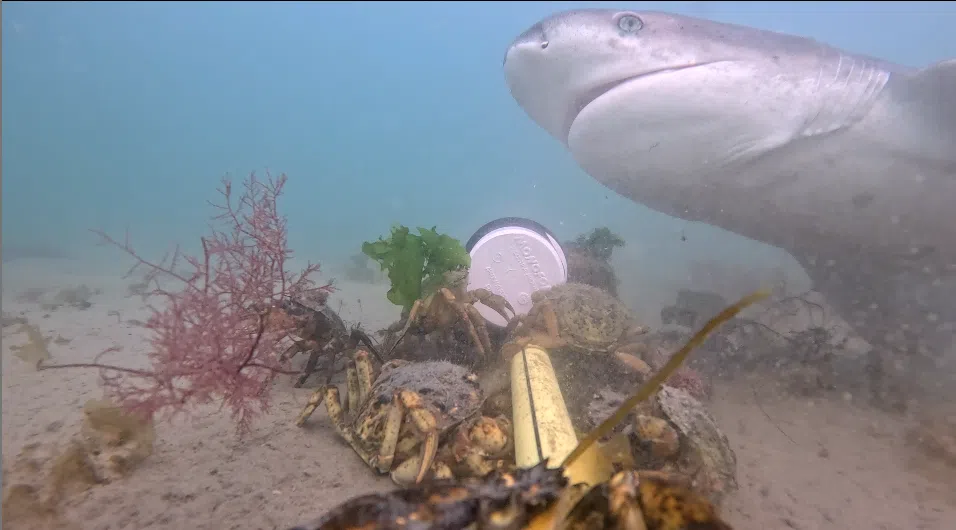 Image of a goblin shark captured by trap cameras.
An ancient lineage and a unique reproductive strategy
The Hexanchiformes order includes only six living species, and the goblin shark stands out for being ovoviviparous: the embryos develop inside the mother from fertilized eggs and are born alive. There are no visible capsules or nests.
Science has identified seasonal aggregation zones and proposes a solid hypothesis: the goblin shark carries out migrations between birthing, breeding, feeding, and mating areas, with differentiated patterns according to sex, age, and reproductive status.
Myths, reality, and conservation campaigns
“It does not pose a threat to people. In half a century, there have been only a couple of non-fatal bite records,” clarifies Gutiérrez.
The image of an aggressive shark, fueled by cinema and pop culture, does not match its behavior. Far from being “relentless,” the goblin shark is a key piece of marine balance.
In Blue Patagonia, the Conservation team initiated capture and tagging campaigns. Females can reach almost 3 meters, although they typically measure 2.60 meters, and are noticeably larger than males. “It’s surprising how calm they are when released back into the water,” Gutiérrez recounts.
Tagging with plastic markers allows for recording movements, growth, and behavior. Additionally, it involves sports fishermen in conservation, leveraging their knowledge of the sea and their seasonal records.
Underwater monitoring and satellite technology
Monitoring is carried out with underwater remote video stations with bait, which allow evaluating the abundance and seasonality of the species in the Park. This system is complemented by plastic tagging and, soon, by satellite devices that will report migratory movements between 6 and 9 months after their placement.
At the national level, campaigns are planned to equip goblin sharks with satellite technology and thus reveal their migratory routes.
In Blue Patagonia, the immediate goal is to deploy at least six devices between November and January, to precisely track this vital phantom of the marine ecosystem.



