



Santa Cruz took a key step by approving a law that declares the Chinook salmon as an invasive exotic species. The regulation enables a control and regulated use plan to reduce impacts in the Santa Cruz River basin.
The goal is to integrate environmental, health, and productive criteria to minimize damage and organize its use. The project reached the chamber after years of monitoring and technical warnings about the expansion of the salmon.
The Legislature approved it unanimously, reflecting widespread concern about its advance. For now, the law awaits its promulgation to launch a comprehensive program throughout the provincial territory.
The Executive will have to coordinate with municipalities, national agencies, scientific institutions, and local communities. The measure seeks to build a sustained environmental policy, based on evidence and social participation. The plan will be funded with provincial funds and may be complemented with national and international cooperation.

A species in expansion that challenges ecological balance
The Chinook salmon is native to the northern hemisphere and arrived in Patagonia in the late 1990s. Since then, it has established self-sustaining populations in glacial melt rivers connected to the ocean.
Its ability to adapt to new environments has driven its continuous advance in basins of high ecological sensitivity. Its biological cycle includes a massive return to rivers to spawn, after which the adults die.
This dynamic leaves large loads of organic matter that alter the water’s nutrient levels. This input modifies the ecological structure of the river courses and impacts various biological communities.
The growth of its populations has also generated social tensions related to poaching. Uncontrolled commercialization has fueled informal circuits with health risks. Meanwhile, the debate on its environmental impact and the need for official intervention has deepened.
A plan to control the invasion and organize utilization
The law declares the species invasive but allows its regulated use under strict criteria. This category seeks to reduce the salmon’s biomass while generating formal economic opportunities. The approach aims for controlled exploitation to contribute to ecological restoration and local development.
The plan will include special permits for artisanal fishing, prioritizing basin inhabitants. It also envisions infrastructure for slaughter, refrigeration, and transport, with health and environmental standards.
Productive management will reduce risks and improve the quality of food derived from the resource. Strategies will be developed to control expansion hotspots in sensitive ecological areas.
Actions will include permanent monitoring, selective removals, and regulation of recreational fishing. The law prohibits introducing Chinook in environments where it is not yet present, preventing new invasions.
The species: characteristics and conservation status
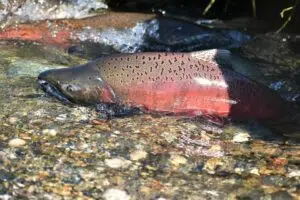
The Chinook salmon, also known as the “king,” is one of the largest salmon species in the world. In its original habitat, it lives in rivers and seas of the northern Pacific, especially in America and Asia. There, it is part of complex migratory cycles and supports fisheries with high ecological and economic value.
Globally, the species is not threatened and maintains robust populations in its native range. Its high reproductive capacity and tolerance to different environmental conditions favor its stability. However, the same set of characteristics facilitates its invasive potential when it reaches new territories.
In regions where it has been introduced, the species often expands rapidly and establishes self-sustaining cycles. Its biological success makes it one of the salmonid species with the greatest colonizing capacity. Therefore, many countries consider it an exotic species with significant ecological risk outside its natural range.
Why the Chinook salmon is invasive and how it affects the Patagonian ecosystem
The Chinook is considered invasive in Patagonia due to its ability to colonize entire basins. Its cycle of massive spawning and associated mortality produces large loads of organic matter in the rivers. This alters the water chemistry, modifies trophic chains, and affects more vulnerable native species.
The excessive nutrient input can generate changes in the biological productivity of the rivers. These changes alter the distribution of invertebrates, native fish, and essential microorganisms. Competition for shelter and food also displaces local species with less adaptive capacity.
The presence of the Chinook can favor synergies with other exotic species, amplifying the impact. Additionally, uncontrolled expansion increases the risk of new invasive hotspots in connected basins. The invasion compromises key ecological processes and affects the balance of ecosystems of high value in Patagonia.



