



With thermal records reaching -71 °C, the capital of Sakha, the coldest city forces its inhabitants to follow strict survival protocols to avoid instant freezing.
In the heart of eastern Siberia lies Yakutsk, internationally recognized as the coldest city in the world.
In this urban settlement, which serves as the capital of the Republic of Sakha, daily life unfolds under thermal conditions that challenge human endurance, with thermometers frequently dropping below -50 °C and historical records that have approached -71 °C in the region.
Living in this environment is not just a matter of adaptation, but of rigorous discipline where any physical neglect can result in permanent frostbite injuries within minutes.

Survival as a daily priority
The main threat in the coldest city in the world is direct exposure to the icy air. Experts and local residents warn that no part of the skin should be exposed; wearing multiple layers of wool and furs is not a luxury, but a vital necessity.
At these temperatures, the breath vapor crystallizes instantly, creating an “ice fog” that envelops the city, while everyday objects like metal glasses become a hazard, as they can stick to the facial skin and cause tears when attempting to remove them.
The impact of extreme cold extends to infrastructure and technology. In Yakutsk, vehicles must remain in heated garages or keep their engines running throughout the day to prevent fuel and lubricants from solidifying.
Additionally, the city is built entirely on permafrost —permanently frozen ground—, which requires buildings to be erected on concrete pilings to prevent the heat from homes from melting the ground and destabilizing the structures.
Oymyakon: the epicenter of polar cold
Although Yakutsk is the most populated urban center in these latitudes, the title of the coldest inhabited point on the planet is contested by the nearby village of Oymyakon. In this small enclave, the lowest temperature in an inhabited area was recorded in 1933: -71.2 °C.
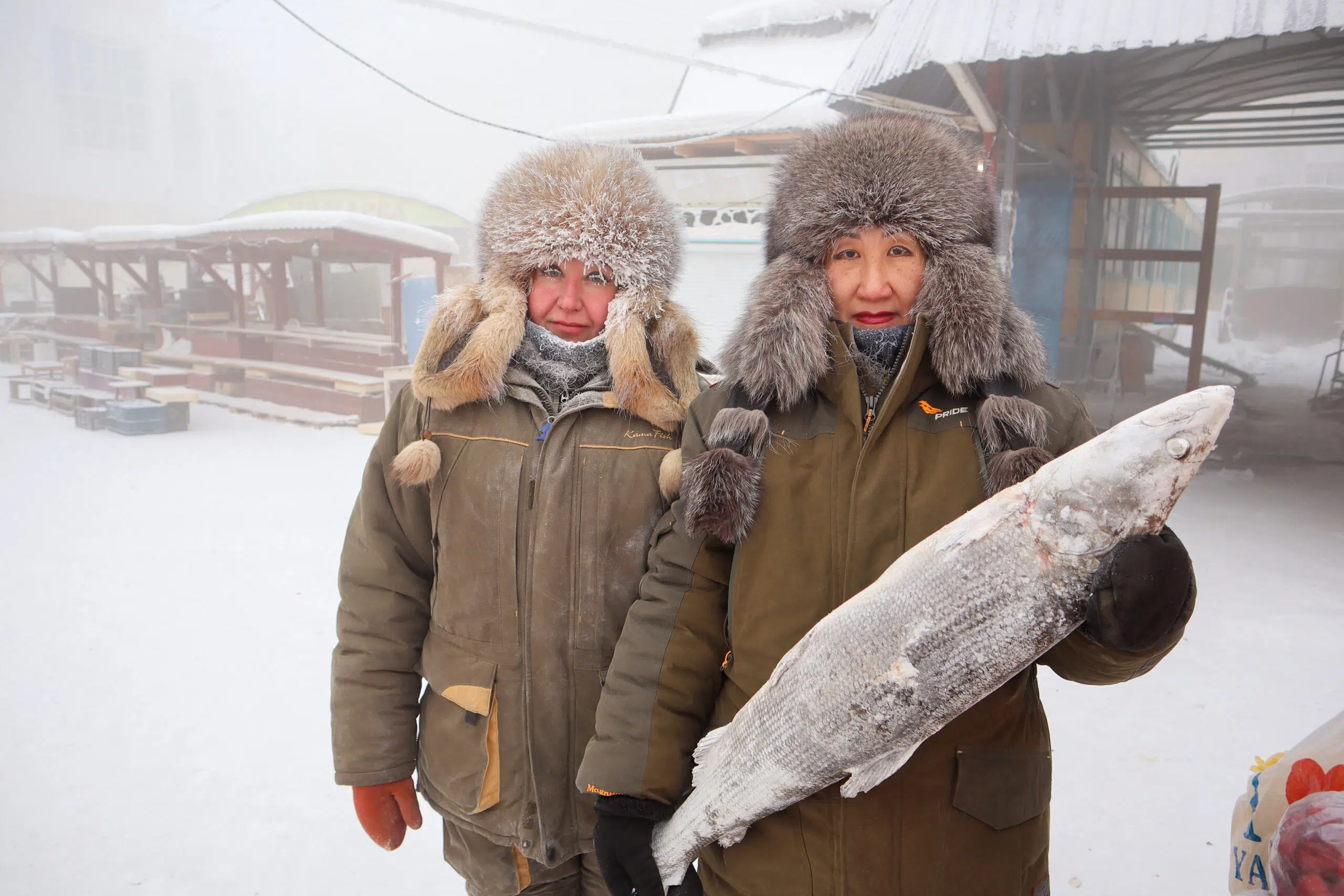
In both places, diet is a key factor for survival, based on high-calorie density foods like frozen raw fish (known as stroganina) and reindeer meat, products that are sold in open-air markets where the cold acts as a permanent natural refrigerator.
Despite the harshness of the climate, the region is a strategic economic engine due to its wealth in natural resources, especially diamond mines and natural gas.
The resilience of its inhabitants demonstrates that, even in the coldest city in the world, human activity and industrial development persist in one of the Earth’s most hostile environments.


