



Between the decades of 1930 and 1970, the United States dumped thousands of barrels with radioactive waste, industrial chemicals, and refinery tailings in deep areas of the Pacific Ocean, off the southern coast of California. The practice, authorized at that time, was based on the idea that ocean depths would act as a permanent dilution medium.
Records from the Environmental Protection Agency (EPA) identify at least 14 official disposal sites, where various materials were deposited: from petroleum refining by-products to obsolete military explosives. The barrels, simple metal containers without long-term storage planning, remained off the scientific radar for decades.
Rediscovery and new technologies
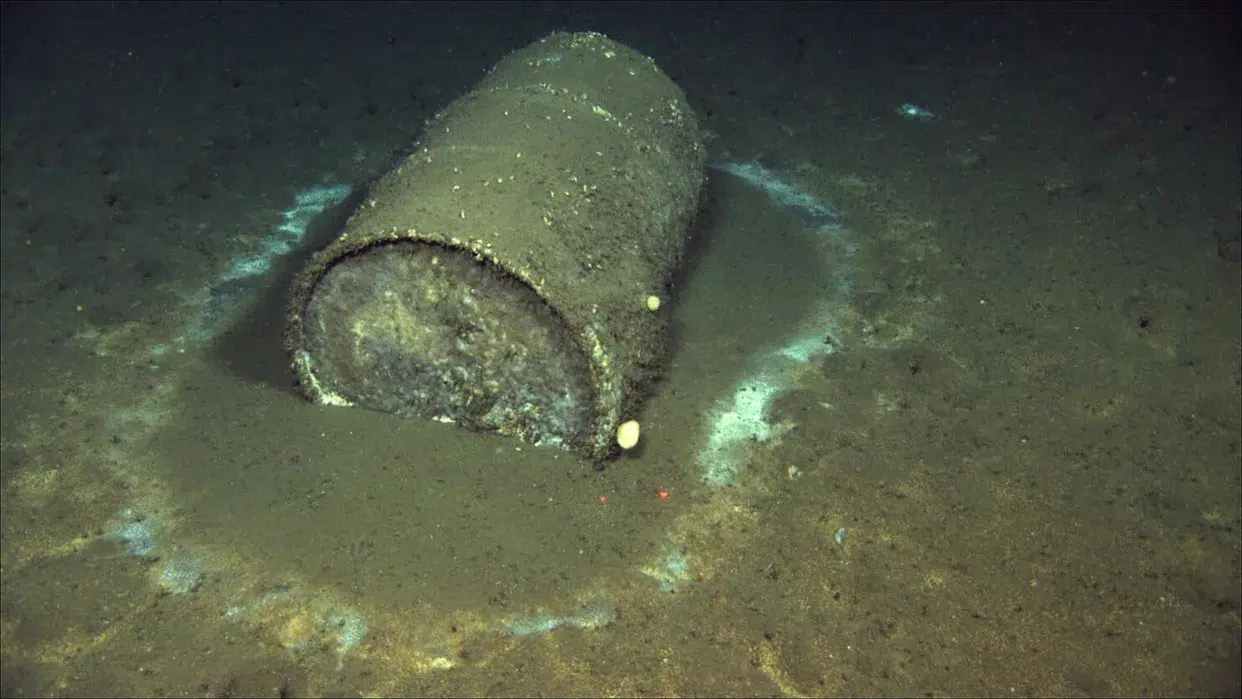
Public interest resurfaced in 2020 when a report from the Los Angeles Times revealed underwater images of corroded barrels surrounded by strange stains on the seabed.
Subsequently, campaigns by the Scripps Institution of Oceanography (University of California) in 2021 and 2023 identified approximately 27,000 objects compatible with barrels and more than 100,000 pieces of debris scattered. These findings confirmed the magnitude of the problem and raised new questions about the contents of the containers.
Initial hypothesis: DDT
For years it was suspected that many barrels contained DDT, a pesticide banned for its environmental persistence and toxicity. The presence of whitish halos in the sediments reinforced this hypothesis.
However, a study led by microbiologist Johanna Gutleben in 2021, published in PNAS Nexus, analyzed sediments near five barrels and concluded that there was no increase in DDT, ruling out that those specific containers were a direct source of the pesticide.
Caustic alkaline waste
The most alarming finding was the detection of extremely high pH (12) in the sediments around three barrels, a level hostile to marine life. The analysis showed minimal amounts of microbial DNA, indicating a drastic reduction in microscopic biodiversity.
Researchers concluded that the barrels contained caustic alkaline waste, capable of destroying organic matter, altering sediment chemistry, and releasing toxic metals. This waste, in concentrations similar to those measured, would be lethal to humans in case of direct exposure.
Formation of the “white halos”
The team explained that the visible halos form when the leaked alkaline material reacts with magnesium in seawater, generating brucite (magnesium hydroxide). This mineral creates a rigid crust that, by dissolving slowly, maintains the elevated pH and triggers new chemical reactions, such as the formation of calcium carbonate.
This process explains why the waste persists for decades instead of dissolving quickly.
Environmental impact and persistence
According to co-author Pablo Jensen, alkaline waste should be considered persistent pollutants, with an impact comparable to that of DDT. More than 50 years later, the chemical effects are still detectable on the ocean floor, suggesting that the legacy of these industrial wastes could influence the ecosystem for centuries.
Uncertainties and challenges
It is still unknown:
- The total number of intact barrels.
- How many have already completely leaked.
- What other types of waste are present.
- If the pollutants enter the food chain.
Researchers estimate that a third of the analyzed barrels present white halos, but it is unclear if this proportion will hold in new areas.
Any monitoring or removal strategy faces enormous technical and financial challenges: the great depth, the fragility of the corroded barrels, and the risk of releasing more pollutants make intervention a complex dilemma.
The case of the radioactive and chemical barrels at the bottom of the Pacific Ocean exposes a hidden legacy of industrialization and U.S. military defense. Although technological advances allow for a better understanding of their impact, uncertainties about their content and the risks of intervention show that this problem will remain an environmental and scientific challenge for decades to come.



