



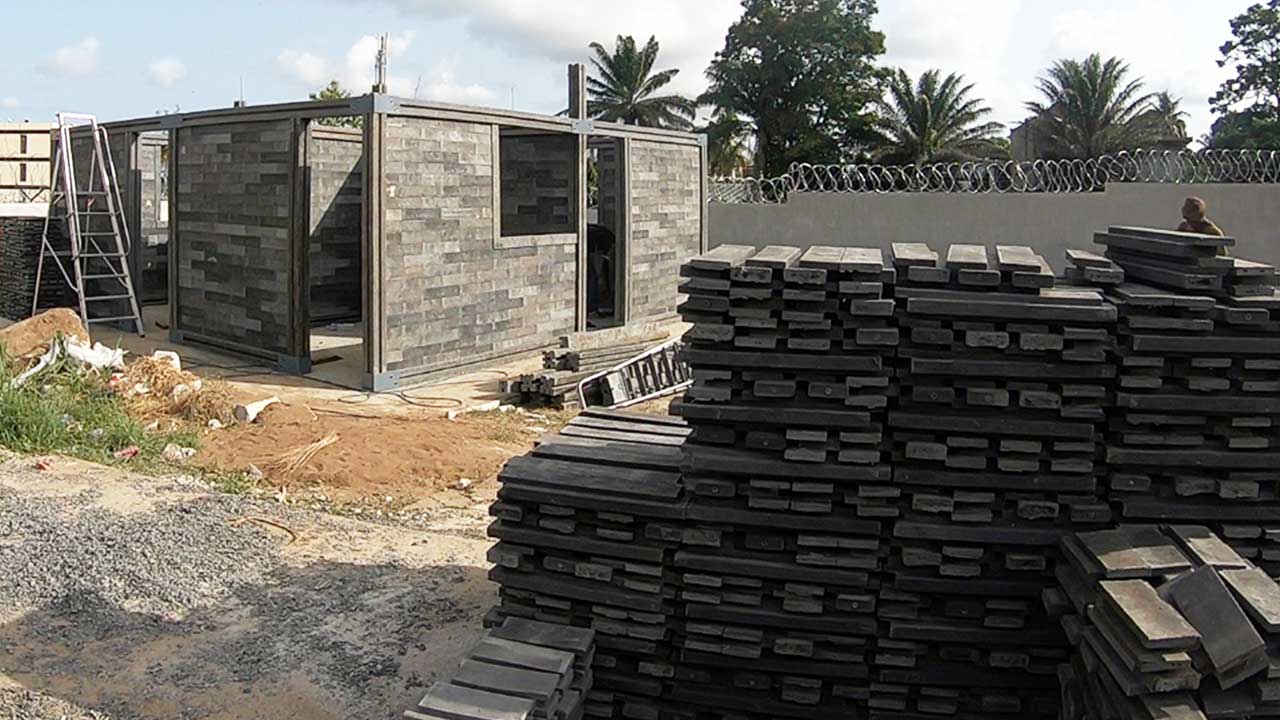
The municipality of Lavalle (Mendoza) took a historic step by approving Ordinance No. 1281, which allows the use of the 3C Construction System as a non-load-bearing enclosure technique in buildings. The regulation, signed on November 18, 2025, and published in the Official Gazette on January 12, 2026, permits the incorporation of compacted plastic waste as part of the construction of walls in houses and buildings.
How the 3C System Works
The system uses blocks or panels made with compacted plastics —mainly polypropylene and expanded polyethylene— joined with metal or plastic meshes. They are then completed with projected plasters to form lightweight vertical enclosures.
The ordinance sets a clear limit: the 3C cannot be used for structural purposes or to support loads. It does not replace columns, beams, or traditional resistant systems, and must always be accompanied by a conventional structure (concrete, steel, or load-bearing masonry).
Highlighted Advantages
The municipality highlights two main benefits:
- Cost reduction: up to 30% compared to traditional methods.
- Positive environmental impact: valorization of plastics that are difficult to dispose of.
Additionally, the system promises faster execution thanks to the use of pre-assembled modules and lower water consumption on site.
Requirements for its Application
Projects using the 3C must present:
- Complete architectural, structural, and installation plans.
- A technical report explaining the use of the system.
- Certifications and tests that prove its suitability.
- Details of finishes, anchors, and protection measures against humidity and solar radiation.
Importance of Plastic Recycling
Plastic recycling is crucial to advancing towards a circular economy and reducing pollution:
- Environmental protection: prevents plastics from ending up in landfills, oceans, and soils.
- Resource conservation: reduces the extraction of oil and gas.
- Energy savings: manufacturing recycled products requires less energy than producing them from scratch.
- Reduction of microplastics: limits fragmentation into particles that pollute water, food, and air.
- New jobs and products: promotes innovative industries in construction, fashion, and furniture.
Role of Public Programs
Initiatives like “BA Recicla” demonstrate how governments can drive the circular economy:
- Facilitate the source separation of waste.
- Create collection and treatment infrastructure.
- Promote citizen education on proper recycling.
- Connect recyclers with the industry, generating productive circuits.
- Transform cities into cleaner and more sustainable spaces.
The approval of the 3C System in Lavalle marks progress towards sustainable construction, integrating plastic waste into residential enclosures. With economic and environmental benefits, the measure reinforces the importance of recycling as a tool to reduce pollution and promote a circular economy.



