



On the Argentine Atlantic Coast, walking barefoot to the sea often becomes a race against the heat. In contrast, on many Caribbean beaches, the sand feels cooler and lighter. This difference is due to deep geological and environmental processes.
Besides the climate, the color and composition of the sand influence how much heat it absorbs. Therefore, two beaches with intense sun can offer opposite thermal experiences.
Thus, understanding what beaches are made of helps explain why some burn and others are more gentle to the touch.
The role of color and minerals
Dark sand, common on the Argentine coast, absorbs more solar radiation. This happens because its reflectance is low, which favors heat storage.
These sediments are mainly composed of quartz, feldspar, and fragments of eroded rocks. Many of them have gray, greenish, or black tones.
As a result, on days of intense heat, the sandy surface can far exceed the air temperature.
From mountains to beaches: a millennial journey
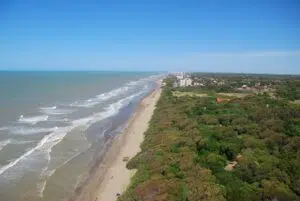
The grains that currently cover the Atlantic Coast were born far from the sea. They come from the erosion of the Andes Mountains and the Pampean sierras.
Over millions of years, water and wind fragmented those rocks. Then, rivers transported the sediments to the ocean.
Finally, marine currents and the waves deposited them on the beaches, forming denser and darker sands.
The Caribbean and its biological sand
In contrast, Caribbean sand has a mostly biological origin. It is composed of remains of mollusks, corals, and other marine organisms.
These beings build their structures with calcium carbonate, a light material that better reflects sunlight. Therefore, the sand heats up less. The waves break down reefs and shells, and then distribute those white fragments along the coast.
Animals that also make beaches
In some areas of the Caribbean, the parrotfish plays a key role. By feeding on algae, cyanobacteria, and small invertebrates attached to the coral, it grinds the substrate.
This material is ingested and then excreted as fine white sand. Over time, this process significantly contributes to the formation of beaches. Thus, marine fauna also shapes the coastal landscape and its temperature.
Other climatic and environmental differences
Beyond the sand, the Caribbean and the Argentine Atlantic Coast present marked contrasts. The Caribbean has warmer waters, a tropical climate, and less annual thermal amplitude.
In contrast, the Argentine coast is influenced by cold currents, strong winds, and more defined seasons. This affects both the sea and the coastal ecosystems.
Moreover, while the Caribbean hosts reefs and high marine biodiversity, the southern Atlantic is characterized by open beaches, large tides, and fauna adapted to more extreme conditions.


