



The Rescue Center of the Mundo Marino Foundation confirmed the reintegration of two juvenile South American fur seals (Arctocephalus australis) on the coast of San Clemente del Tuyú.
One of them had been found with a deep wound on the neck, consistent with the pressure of a plastic strap or net remnant, while the other was admitted with a mild case of dehydration.
The first animal was found on January 25 in Villa Gesell by members of the organization Rescate Verdemar, who immediately notified the Foundation. The circumferential lesion in the cervical region showed the impact of rigid marine debris, which, when trapped on the body, causes constant friction and can lead to infections, amputations, or even death.
Veterinary Treatment
For almost a month, the fur seal remained under intensive care:
- Periodic treatments with antiseptics and antibiotic and anti-inflammatory ointments.
- Pain management with analgesics.
- Controlled hydration and deworming.
- Vitamin-mineral reinforcement and clinical monitoring through blood tests.
The progression was favorable: it regained body condition, maintained a good attitude and autonomous feeding, and the wound healed completely. Once stabilized, it received medical-veterinary discharge.
The second specimen, rescued on February 4 in Santa Teresita, showed mild dehydration. After oral hydration, deworming, and clinical controls, it reached ideal weight and adequate body condition, which allowed its reintegration along with the first.
The Return to the Sea
Both animals were released on February 20 on the coast of San Clemente del Tuyú, after verifying their optimal physical and behavioral conditions for returning to the natural environment.
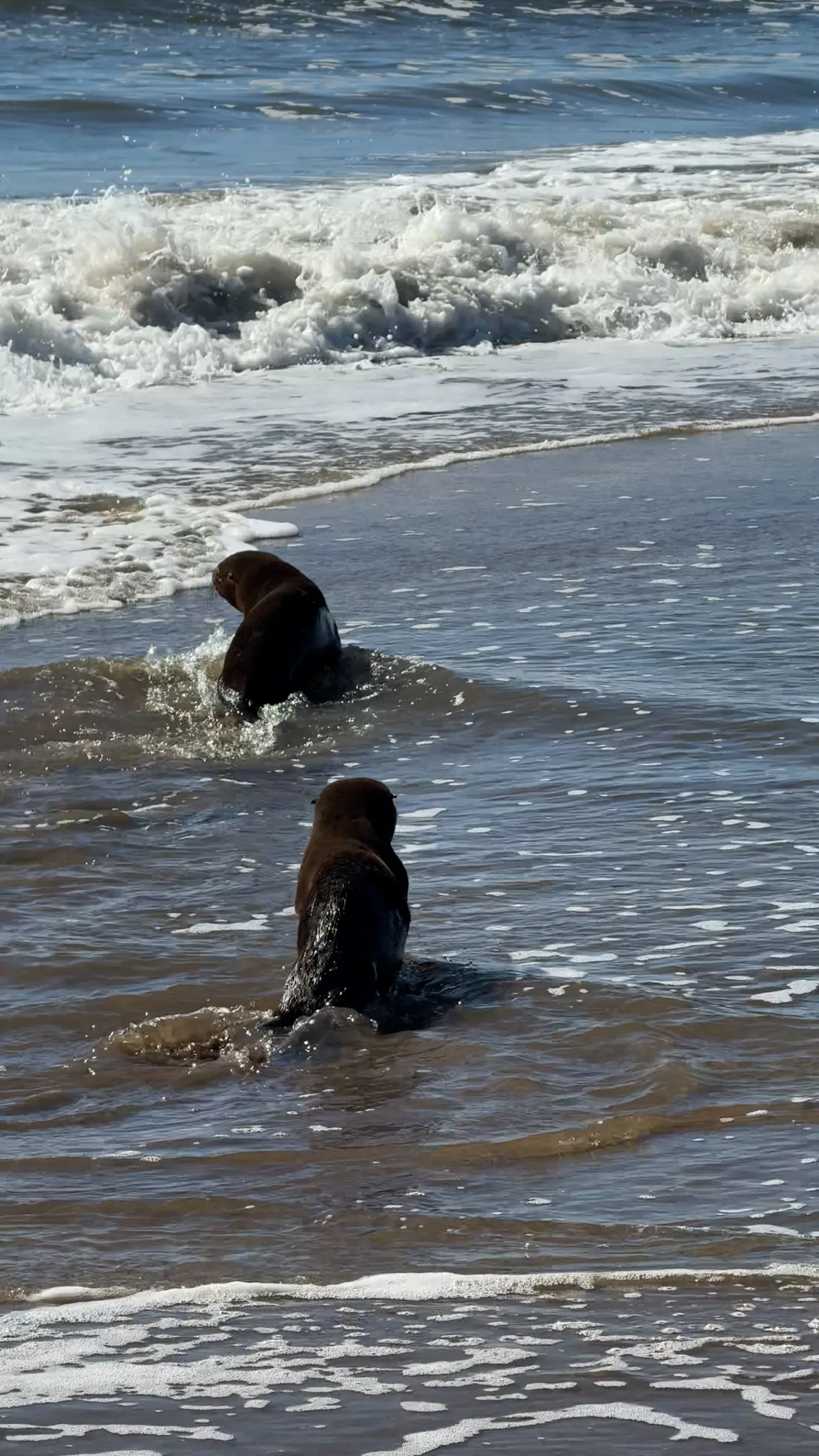
According to biologist Sergio Rodríguez Heredia, head of the Rescue Center, cases associated with plastic waste in the coastal environment are attended to every year. Straps, nets, and other non-degradable materials become traps for marine fauna, causing progressive injuries and endangering their survival.
The Species: South American Fur Seal
- Belongs to the otariid family, differentiating from seals by having an auricle and using their hind flippers for locomotion.
- Its distribution ranges from Isla de Marco (Uruguay) to Isla Mayorca (Peru), with large colonies on the Uruguayan islands of the Río de la Plata.
- The name comes from its two layers of fur: an internal waterproof one and an external one that provides color.
- Males reach up to 2 meters in length and 150 kg, while females reach 1.40 meters and 60 kg.
- Their diet includes prawns, shrimp, squid, and fish.
The case of these two fur seals highlights the importance of rescue and rehabilitation programs, as well as the need to reduce plastic pollution in the seas. Each successful reintegration not only returns an animal to its habitat but also reinforces awareness of the fragility of marine ecosystems and the urgency to protect them.



