



The United States government authorized the launch of a pilot program aimed at testing electric air taxis and new advanced air mobility technologies.
The initiative was announced on March 9, 2026 by the United States Department of Transportation and the Federal Aviation Administration.
The project seeks to evaluate the use of electric aircraft for vertical takeoff and landing in real conditions within the national transportation system.
The tests will be conducted in 26 states and will bring together public agencies, tech companies, and local transportation agencies. The goal is to analyze the operation of these aircraft in passenger transport, cargo transport, medical services, and autonomous operations.

A program to test the future of air mobility
The pilot program, known as the integration of advanced air mobility and eVTOL aircraft, selected eight technological proposals. Among the participating companies are Joby Aviation, Archer Aviation, BETA Technologies, Electra.aero, Wisk Aero, Ampaire, Elroy Air, and Reliable Robotics.
These companies are developing aircraft capable of vertical takeoff and landing using electric or hybrid engines. The first operational tests are scheduled for the summer of 2026 and will allow data collection on safety, efficiency, and operation.
Additionally, how these aircraft interact with airports, heliports, and existing airspace will be analyzed. The information obtained will be used to design specific regulations governing this new form of transportation.
States and regions where the tests will be conducted
The tests will be conducted in multiple regions of the country, from the East Coast to the western United States. The Texas Department of Transportation will coordinate trials connecting the cities of Dallas, Austin, San Antonio, and Houston.
In the Northeast, the Port Authority of New York and New Jersey will lead studies on air mobility in the New England region. Likewise, the Utah Department of Transportation will conduct tests in areas of the Pacific Northwest, the Rocky Mountains, and the Great Plains.
Meanwhile, the Florida Department of Transportation will focus its operations on cargo transport, medical flights, and automation. Authorities from North Carolina, Pennsylvania, and the city of Albuquerque will also participate.
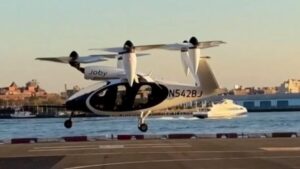
What eVTOLs and advanced air mobility are
eVTOL vehicles are aircraft powered by electric engines capable of taking off and landing in small spaces. Unlike helicopters, they use multiple electric rotors that reduce energy consumption and noise levels.
These aircraft can transport passengers or goods and are designed to operate in cities or rural regions. Advanced air mobility integrates these aircraft with autonomous systems, transportation networks, and new infrastructures.
The goal is to expand air mobility options in urban, suburban, and regional areas. The tests will allow evaluation of key aspects such as safety, environmental impact, noise, and energy efficiency.
Electric air mobility and its multiple benefits
The implementation of electric air taxis could bring significant environmental benefits. By using electric engines, these aircraft generate fewer direct emissions than conventional helicopters or planes.
This could help reduce the carbon footprint of transportation, especially on short urban or regional routes. Additionally, the use of electric technologies allows for a significant reduction in noise levels compared to traditional aircraft.
They could also improve connectivity in rural or isolated areas where ground transportation is limited. Another potential advantage is the speed in transporting patients, medical equipment, or supplies in emergency situations.
For these reasons, experts believe that advanced air mobility could become a key tool in building more sustainable transportation systems. However, the results of the pilot program will be crucial to evaluate its technical, economic, and environmental feasibility in the future.



