



In recent days, the Argentine Naval Prefecture intercepted three foreign-flagged vessels in the Argentine Exclusive Economic Zone (ZEEA), as part of the “zero tolerance” policy against illegal, unreported, and unregulated (IUU) fishing.
The strategy combines presence at sea with electronic detection technology, allowing for economic sanctions on offending vessels even without physical capture.
Recent Cases
Among the most relevant episodes are:
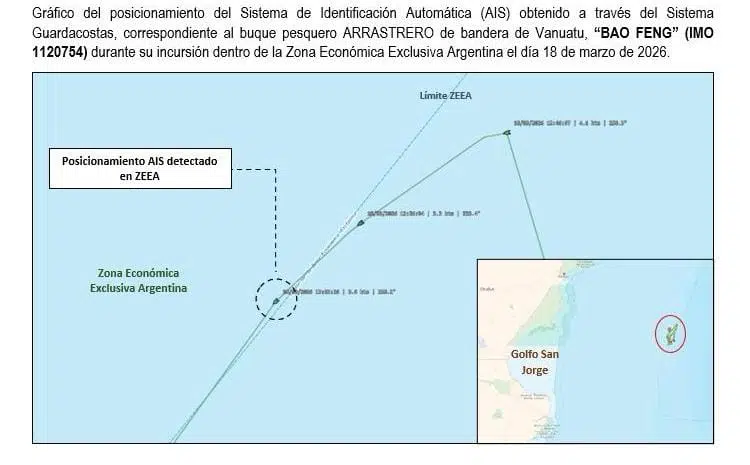
- BAO FENG (Vanuatu): detected on January 10 conducting trawling activities at less than 6 knots within the ZEEA. A fine of more than 1.262 billion pesos was imposed, in addition to operational costs of almost 800 thousand pesos. The vessel reoffended days ago.
- HAI XING 2: located with typical fishing patterns, navigating at speeds of 4.3 knots and remaining in the area.
- BAO WIN: identified with reduced movements and repeated maneuvers, compatible with extractive practices.
The SSRAyP Provision No. 20/2026 establishes that any foreign vessel moving at less than 6 knots and executing fishing maneuvers within the ZEEA is presumed to be in violation.
Technology and Sanctions
The Naval Prefecture and the Undersecretariat of Aquatic Resources and Fishing apply sanctions based on high-precision electronic evidence, without the need for the physical presence of offenders.
The satellite system SITRAM allows tracking of vessels that turn off their automatic identification systems (AIS) to conceal their activity.
The “mile 201” and International Pressure
The concentration of more than 500 foreign vessels —mainly flagged by China, Spain, and convenience flags like Vanuatu— in the so-called “mile 201” creates constant pressure on the South Atlantic.
- Economic impact: estimated losses of US$ 1 billion annually.
- Environmental impact: overfishing affecting Argentine marine biodiversity and ecosystems.
- Flag of convenience: allows fleets to evade safety, labor, and environmental controls.
- Labor abuses: reports from the Environmental Justice Foundation (EJF) denounce forced labor and human rights violations in Asian fleets.
Defense of Sovereignty and Sustainability
The frequency of these events reinforces the need for permanent monitoring and the application of effective sanctions. Argentina reaffirms its commitment to the defense of sovereignty, the protection of natural resources, and the sustainability of marine ecosystems, ensuring that any illegal activity within its waters is detected and penalized.
The “zero tolerance” policy against illegal fishing in the ZEEA is consolidated as a key mechanism to face the pressure of international fleets. The combination of satellite technology, economic sanctions, and institutional coordination allows Argentina to protect its fishing resources and ensure the sustainability of the South Atlantic.



