



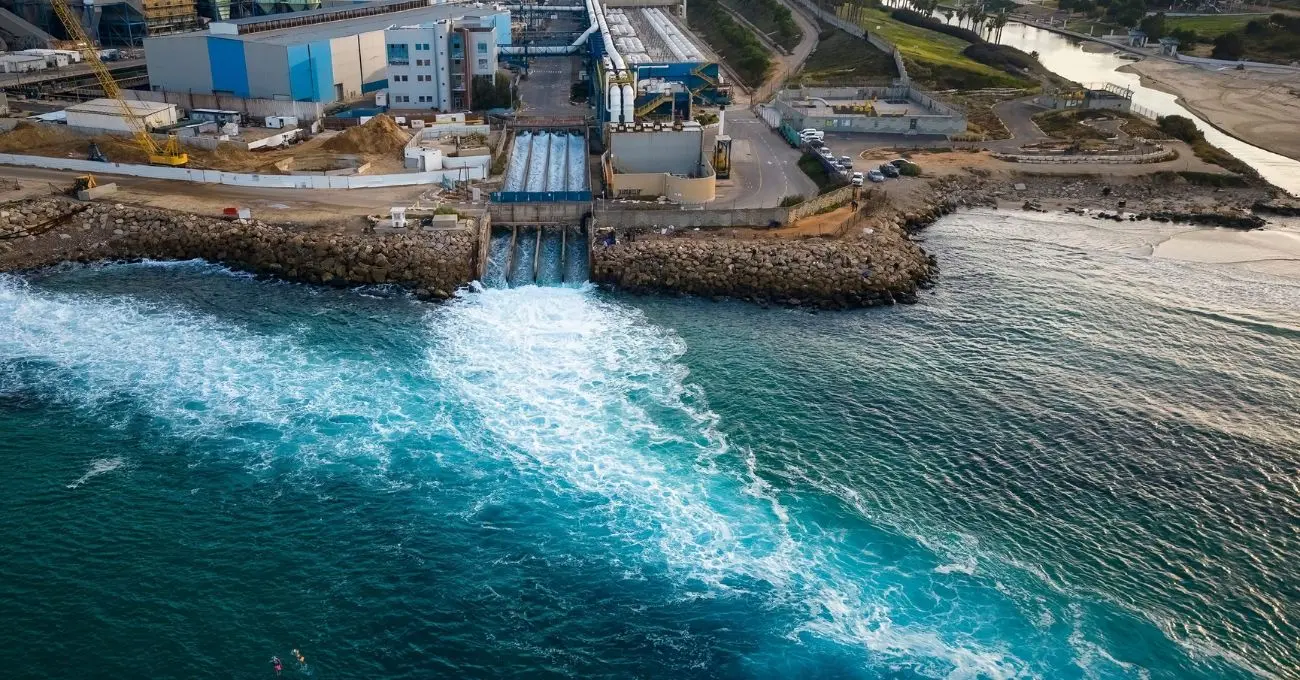
What began as a timely response to the drought in California has transformed into a national strategy: The United States is promoting large-scale desalination plants to convert ocean water into potable water. This movement seeks to ensure urban, agricultural, and industrial supply amidst the climate crisis, marking a before and after in water management.
For decades, desalination was considered an expensive and limited alternative. However, in 2026 the scenario changed: coastal cities are beginning to look to the sea as a stable and permanent source of water, integrating these plants into the national water system.
How the process works
Desalination is developed in several phases:
- Intake: coastal pipes collect ocean water, avoiding sand, algae, and marine fauna.
- Initial filtration: small particles and microorganisms are removed.
- Reverse osmosis: high pressure is applied to force the water through membranes that block salt and other substances.
- Remineralization: minerals are added to make it safe, improve taste, and protect pipes.
- Distribution: the water is sent to cities, agriculture, and industries.
Strategic importance
Desalination provides key benefits:
- Water security: constant source independent of rainfall.
- Urban supply: ensures potable water in coastal and arid areas.
- Agriculture: ensures irrigation in areas with water deficits.
- Industry and mining: provides large volumes without depleting local aquifers.
- Ecosystem protection: reduces pressure on rivers and groundwater.
Currently, there are about 22,000 plants worldwide supplying more than 100 million people, and the United States is joining with large-scale projects in critical regions like the west of the country.
Pending challenges
Although essential, desalination faces challenges:
- High energy consumption: represents between 35% and 50% of the operating cost.
- Brine management: the saline residue must be treated to avoid environmental impacts.
- Sustainability: efforts are being made to integrate renewable energies to reduce the carbon footprint.
International projection
The U.S. commitment to desalination joins experiences in countries like Israel, Saudi Arabia, and Spain, where the sea already functions as a permanent source of water. In Latin America, Chile and Mexico are also studying similar projects to face prolonged droughts.
This advancement places the United States at the forefront of global water security, showing that the ocean can become a strategic ally against climate change.
The expansion of desalination in the United States marks a structural change in water management. The ocean ceases to be an emergency resource to become a permanent reserve that supports cities, crops, and industries. Amidst the climate crisis, this strategy emerges as a key piece to ensure resilience against prolonged droughts and secure the country’s water future.


