



The fast fashion industry produces around 150 billion garments each year, according to the World Economic Forum. Of these, 92 million tons end up discarded, equivalent to a garbage truck full of clothes every second.
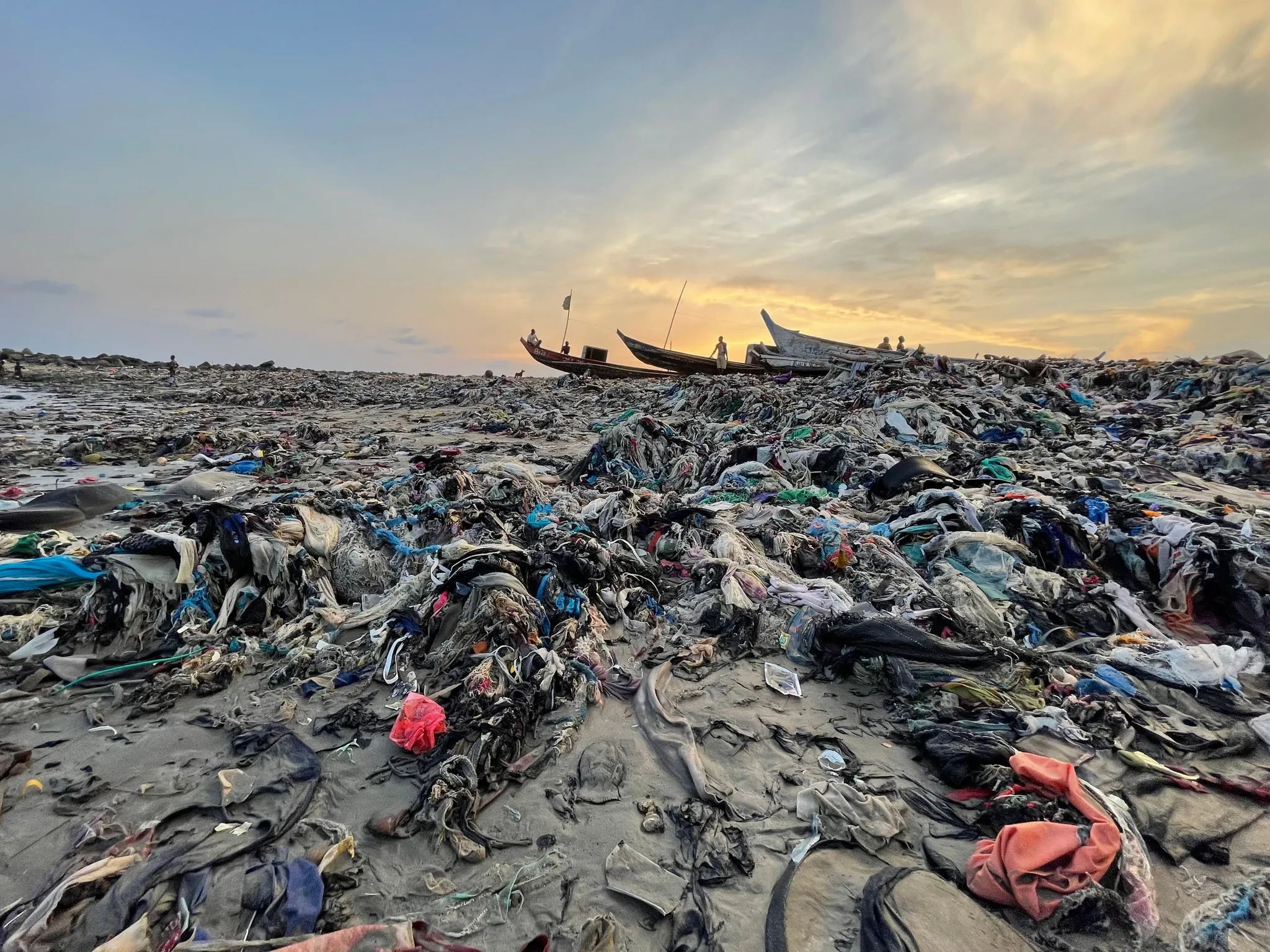
A large portion of this waste is exported to the Global South, where countries like Ghana have become textile dumps. There, about 15 million used garments arrive each week from Europe, Asia, and the Middle East.
Ghana: Dumping Ground for Fast Fashion
In Ghana, discarded clothing is known as obroni wawu (“dead white man’s clothes” in Akan). Although this trade generated employment and access to affordable clothing for decades, the model collapsed:
- The value per kilogram of exports from the United Kingdom fell by 15% in the last decade.
- 40% of the garments arriving weekly are unusable.
- In the Kantamanto market (Accra) alone, 100 tons of waste are generated daily, of which only 30 can be processed. The rest ends up in illegal dumps, drains, lagoons, and wetlands.
Protected Wetlands Under Threat
Research by Unearthed and Greenpeace Africa documented accumulations of clothing from brands like Zara, H&M, Primark, and Marks & Spencer in the Densu Delta, a wetland recognized as a Ramsar Site of international importance.
This ecosystem hosts:
- 60 species of water birds.
- Nesting areas for endangered sea turtles.
The invasion of textile waste also affects fishing communities: garments get tangled in nets, and microplastics released by synthetic fibers pollute the water, endangering the food chain and human health.
An Unsustainable Model
The crisis reflects the impact of the global production and consumption model:
- Clothing production has doubled since the year 2000.
- Exporting countries, like the United Kingdom, sent over 57,000 tons of used clothing to Ghana in 2024.
- The United Arab Emirates functions as a re-export hub.
In Latin America, Chile and Guatemala are the main importers of used clothing, as they do not apply tariffs or restrictions. Chile receives about 60,000 tons a year, of which 40,000 end up discarded in the Atacama Desert.
Environmental and Social Consequences
The accumulation of clothing in wetlands and fragile ecosystems generates:
- Microplastic pollution.
- Loss of biodiversity.
- Risks to human health due to the bioaccumulation of toxins.
- Economic impact on fishing communities and local merchants.
Towards Responsible Consumption
Greenpeace warns that fast fashion is out of control and calls for a rethink of consumption. The claim of fashion as personal expression must go through responsible consumption and care for the planet.
The crisis in Ghana and other Global South countries is a reminder that fashion does not end in shop windows: its waste has global consequences that affect ecosystems, communities, and the health of millions of people.



