



The whaling season has resumed in Iceland after two years of inactivity, a decision that has reignited the international discussion on the protection of cetaceans and the conservation of marine ecosystems.
Two vessels departed over the weekend from Icelandic ports to resume a practice that the country maintains along with Norway and Japan, the only nations that continue to authorize the commercial capture of whales.
The measure comes in a context of increasing environmental pressure and changes in public perception about the ecological value of these species, considered fundamental for the balance of the oceans.
Additionally, conservation organizations and animal rights groups have once again protested to demand the definitive end of this activity.

A sector in crisis trying to recover activity
The resumption of the season occurs after two years marked by uncertainty. In 2024, Icelandic authorities delayed the authorization for whaling beyond the scheduled start of the season.
Ultimately, that campaign was suspended amid an intense national debate on animal welfare and the sustainability of the activity.
Subsequently, during 2025, the companies linked to the sector concluded that the operation would not be profitable due to the economic difficulties faced by the whaling industry.
However, in 2026 the vessels set sail again, allowing the formal restart of captures in Icelandic waters.
Protests and challenges to the activity
The return of the ships was not without controversy. One of the whaling vessels, the Hvalur 9, left the port of Reykjavík with an activist installed on its mast as a form of protest.
The action mirrored similar demonstrations recorded in previous years and once again highlighted the rejection by numerous sectors of society of the commercial whaling of cetaceans.
Meanwhile, the organization Hvalavinir, known as Friends of the Whales, called for new demonstrations in Reykjavík to demand the definitive closure of the activity.
Meanwhile, the debate also reached the political arena, where different sectors are pushing for stricter restrictions to protect the populations of North Atlantic whales.
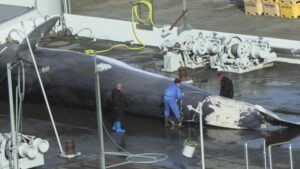
Why Iceland suspended the whaling season
The interruption of the activity in 2024 was related to concerns about the impact of whaling on animal welfare and the need to review the methods used by the industry.
Additionally, authorities evaluated scientific studies that raised concerns about the suffering caused during captures and the need to strengthen animal protection standards.
Subsequently, the economic situation of the sector also influenced the lack of activity during 2025, when companies considered that the season would be financially unviable.
These factors contributed to a two-year pause that many environmental groups interpreted as an opportunity to move towards a definitive ban.
Lower quotas and conservation prospects
This year, the Icelandic Marine Research Institute recommended reducing the authorized capture quotas by approximately 20%.
The suggestions set a limit of 150 specimens of fin whale and 168 individuals of minke whale, due to assessments reflecting lower populations than previously estimated.
On the other hand, the Icelandic government is considering new regulatory measures. The Minister of Industry and Commerce, Hanna Katrín Friðriksson, announced the intention to promote a legislative project aimed at banning commercial whaling.
If this initiative is realized, Iceland could join the growing list of countries prioritizing the conservation of cetaceans, essential species for ocean health due to their role in the nutrient cycle, carbon storage, and the maintenance of marine biodiversity.


