



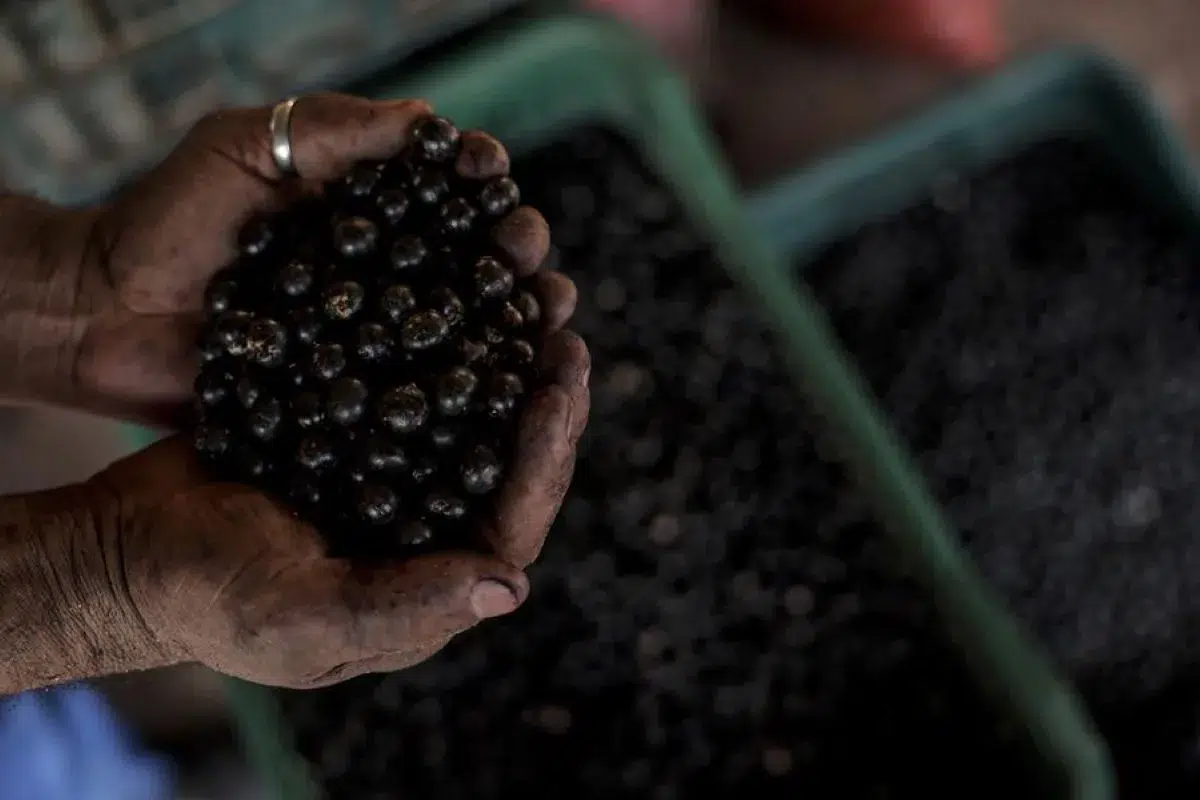
The growing consumption of açaí, globally promoted as a sustainable superfood, is generating worrying consequences in the Amazon.
A study published in Biological Conservation revealed a 28% decrease in the richness of bird species in areas with high density of açaí palms.
The expansion of monoculture in the state of Pará, where 95% of Brazilian production is concentrated, involves the felling of native trees and undergrowth vegetation, destroying vital habitats for frugivorous and insectivorous birds.
The scientific study
Researchers monitored 36 forest areas in municipalities such as Belém, Barcarena, Abaetetuba, and Igarapé-Miri. Through 127 hours of acoustic recordings, they recorded sounds of nearly 3,580 birds. The results showed:
- Reduction of frugivorous birds, essential seed dispersers for forest regeneration.
- Decrease of insectivorous birds, linked to the undergrowth that is often cleared to facilitate harvesting.
- Biotic homogenization, meaning poorer and less diverse bird communities.
Some adaptable species, like the great kiskadee (Pitangus sulphuratus), thrive in modified areas. In contrast, specialist birds such as the long-tailed hermit (Phaethornis superciliosus) or large frugivores like the razor-billed curassow (Pauxi tuberosa) have disappeared in certain areas.
Ecological consequences
The impact goes beyond the reduction of food:
- The white-throated toucans (Ramphastos tucanus) no longer find tall trees to nest.
- The loss of vegetation cover dries the soil and alters the dynamics of flooded forests.
- The balance of ecological interactions that took millennia to consolidate is disrupted.
The economic boom of açaí
Brazilian production has multiplied by 14 since 1987, reaching 1.9 million metric tons in 2024. Exports from Pará grew 885% in a decade, with sales of 177.2 million dollars in 2025. The United States is the main destination, followed by Australia, Japan, and the Netherlands.
This growth responds to the international demand for healthy foods but also exposes the risks of a predatory monoculture.
Alternatives and solutions
Specialists propose:
- Discouraging the monoculture of açaí.
- Encouraging complementary crops such as cacao or andiroba, which generate income and promote biodiversity.
- Strengthening the Amazonian bioeconomy, based on the diversity of forest products and the protagonism of local and indigenous communities.
Economic and reputational risks
According to Danielle Leal Ramos from the University of Exeter, moving away from traditional farming practices implies:
- Loss of opportunities in the emerging green market.
- Risk to the reputation of açaí as a sustainable product.
- Reduction of the resilience of intensive production systems.
Açaí, a symbol of sustainability and a driver of the Amazonian bioeconomy, faces the challenge of not becoming synonymous with degradation. Scientific evidence shows that monoculture threatens biodiversity and ecosystem services.
The future of açaí will depend on balancing global demand with agricultural practices that respect the forest and its species.


