



For years, sargassum was one of the biggest environmental challenges for the Mexican Caribbean coasts. Its massive arrival affected tourism, fishing, and coastal ecosystems.
Today, a plant located in Puerto Morelos, Quintana Roo, transforms daily tons of this macroalgae into organic fertilizer, already exported to the United States, Colombia, and Ecuador, with plans to expand to Europe and Brazil.
Innovation and Circular Economy
The initiative combines technological innovation and circular economy:
- Processes 27 tons daily of sargassum through cleaning, decontamination, and transformation.
- Produces liquid fertilizer suitable for horticultural crops, berries, and regenerative agriculture systems.
- Plans to reach 500,000 liters of fertilizer, backed by long-term international contracts.
This model turns an environmental liability into a high-value agricultural input, reducing the use of synthetic products and improving soil health.
International Expansion
The company plans to triple or quadruple its processing capacity to respond to the growth of exports. International interest is explained by the growing demand for biofertilizers in intensive and sustainable systems.
Target markets include:
- America: consolidation in the U.S., Colombia, and Ecuador.
- Europe and Brazil: where the demand for bio-inputs for intensive productions is increasing.
Environmental and Social Benefits
The industrial use of sargassum offers multiple benefits:
- Waste reduction: decreases the volume of algae accumulated on beaches.
- Ecosystem protection: prevents sargassum masses from blocking sunlight and affecting coral reefs.
- Public health: reduces the emission of toxic gases like hydrogen sulfide, which causes headaches and respiratory problems.
- Local economy: generates employment and new value chains linked to agriculture.
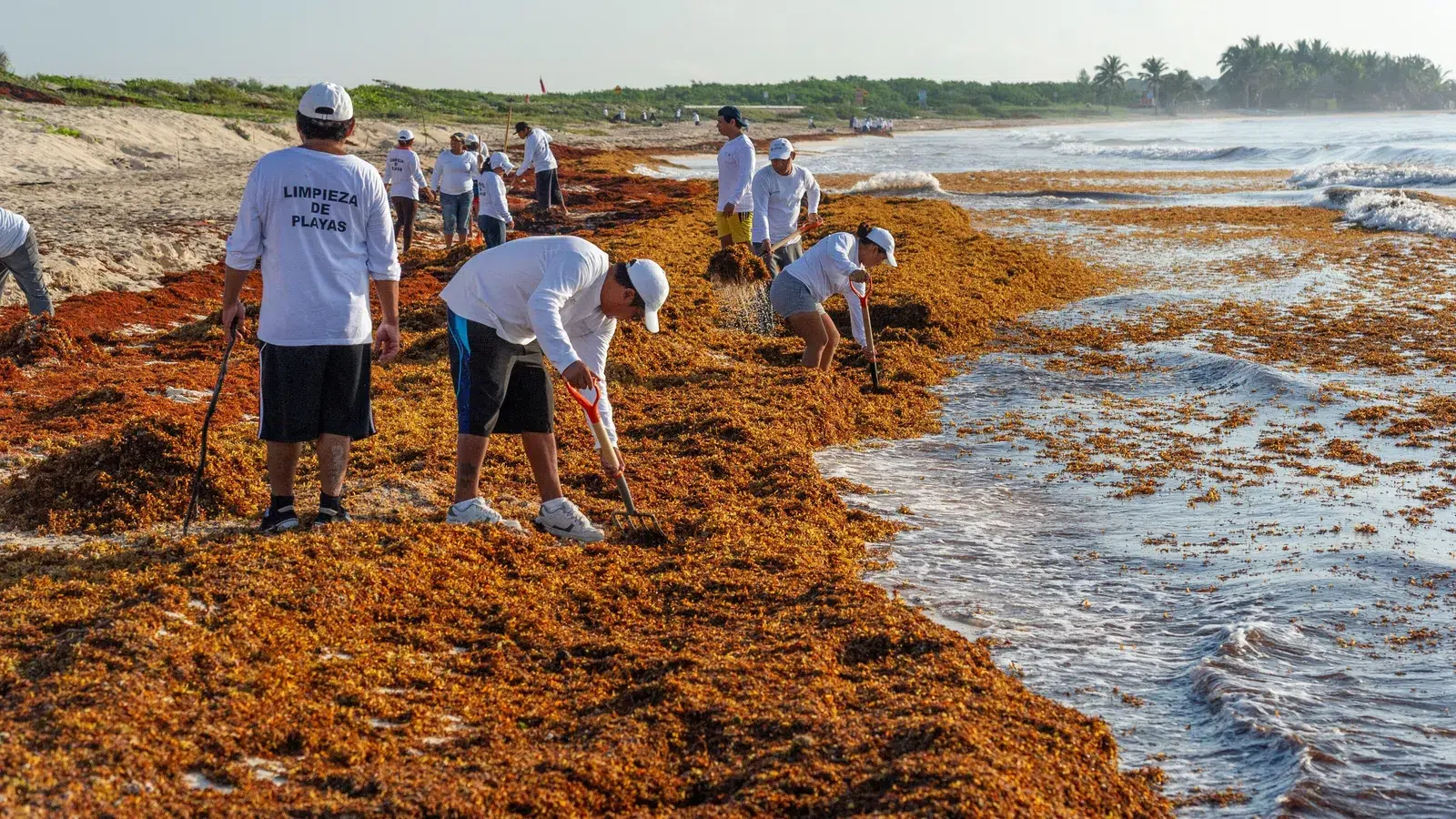
Problem Context
Sargassum arrives massively in the Mexican Caribbean due to climate change and water pollution. Its main impacts are:
- Ecosystem damage: affects reefs and coral photosynthesis.
- Health impact: toxic gases when decomposing in the sand.
- Economic crisis: decline in tourism in destinations like Cancun, Tulum, and Playa del Carmen.
Possible Complementary Solutions
In addition to industrial use, other measures are applied:
- Removal and cleaning: sargassum boats and beach crews coordinated by the Navy Secretariat.
- Applied research: projects by UNAM and Mexican companies to transform sargassum into biofuels, construction materials, and other products.
The case of Puerto Morelos demonstrates how the circular economy can transform an environmental problem into an agricultural and commercial opportunity.
Sargassum, once a symbol of crisis in the Caribbean, is turned into organic fertilizer that conquers international markets, providing sustainable solutions and generating economic value.



