



The use of technology applied to conservation continues to yield results in protected areas. On this occasion, monitoring through camera traps confirmed the presence of the taruca (Hippocamelus antisensis) in a sector of the park where there were no previous records.
Thus, the discovery not only expands the scientific knowledge about the species but also reinforces protection strategies in mountain ecosystems. Additionally, it highlights the importance of maintaining long-term environmental monitoring programs.
At the same time, this type of advancement demonstrates how non-invasive tools can provide key data without altering the natural behavior of wildlife. Therefore, it consolidates a more respectful and effective approach to studying biodiversity.

Technology at the service of conservation
The record in the Parque Nacional Los Cardones was possible thanks to the installation of camera traps, devices that capture images of animals in their habitat without direct human intervention.
In this sense, the methodology allowed the detection of the taruca in an area where it had not been observed before, opening new lines of research on its territorial distribution. It also enables a better understanding of its habits and movement patterns.
On the other hand, specialists highlight that these systems are fundamental for monitoring elusive species or those with low population density. Consequently, they become strategic allies for the management of protected areas.
Finally, the incorporation of these technologies reinforces control and surveillance programs, contributing to decision-making based on scientific evidence.
An emblematic species of the Andes
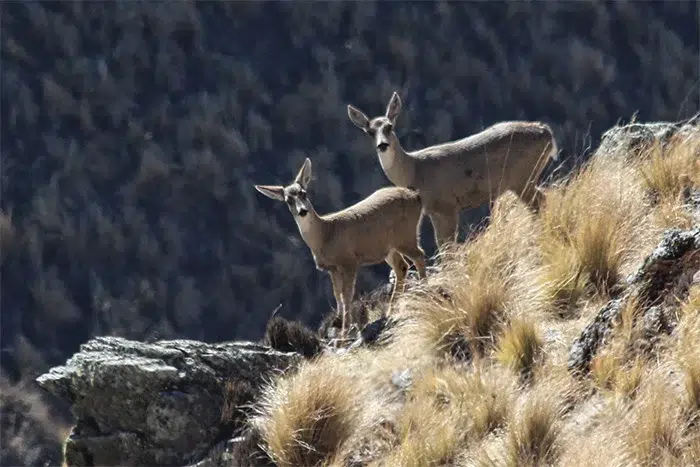
The taruca is an Andean deer adapted to high-altitude environments, where it finds refuge in rocky terrains and mountain grasslands.
Additionally, it plays a key ecological role by participating in the dynamics of vegetation, acting as a regulating herbivore within these fragile ecosystems. Therefore, its presence is an indicator of environmental balance.
However, its survival has been historically threatened by hunting, habitat loss, and ecosystem fragmentation. Therefore, each new record represents an opportunity to strengthen its conservation.
In this context, expanding knowledge about its distribution is essential for designing more effective environmental policies.
Its conservation status and current challenges
Currently, the taruca is considered a vulnerable species in several regions of South America, which implies a high risk of population decline.
Consequently, conservation efforts focus on protecting its habitat, reducing human pressure, and promoting connectivity between natural areas. Additionally, there is an effort to strengthen environmental education in nearby communities.
On the other hand, constant monitoring allows for the detection of changes in populations and anticipation of possible threats. In this way, preventive actions can be implemented more quickly.
Ultimately, the challenge lies in sustaining comprehensive policies that consider both the protection of the environment and social participation.
A step further towards biodiversity protection
The recent record of the taruca in a new area of the park represents a significant advancement for the conservation of Andean wildlife.
At the same time, it reaffirms the importance of investing in technology and in sustained monitoring programs over time. Thus, it strengthens the ability to respond to environmental changes.
In parallel, this type of finding invites a rethinking of the relationship between society and nature, promoting a more conscious perspective on the protection of ecosystems.
In conclusion, each piece of data obtained in the field becomes a key piece for preserving emblematic species and ensuring the balance of mountain environments.



