



In July 2024, a fisherman caught a juvenile sturgeon in the waters of the Rio de la Plata and donated it to the National University of La Plata (UNLP). The finding was surprising because it is a prehistoric species, resembling a shark, that can reach up to four meters in length.
Although its presence in Argentina remains a mystery, scientists warn that its arrival could disrupt the ecological balance of the river.
A living fossil in Argentine waters
Originally from North America, Europe, Africa, and Asia, the sturgeon has survived mass extinctions and retains primitive features such as its cartilaginous skeleton and a tail similar to that of sharks.
In its native regions, it is threatened by commercial exploitation, especially for the production of caviar, which can be valued at over $35,000 per kilogram.
In Argentina, the first record dates back to 1999, and it is presumed that the specimens come from the Uruguayan farm Black River Caviar, located on the Rio Negro, from where they would have escaped after a flood.
Scientific research and citizen science: a key alliance
The team from the Institute of Limnology (ILPLA), composed of Darío Colautti, Tomás Maiztegui, Vivian Yorojo Moreno, and zoology students, preserves three juvenile sturgeons of the species Acipenser baerii and Acipenser gueldenstati.
The capture of these fish is difficult and depends largely on the collaboration of sports and artisanal fishermen.
In 2023, lawyer Claudio Velardo donated a specimen caught in Punta Lara, and the store Mantungo Pesca in Berisso offered a prize for those who delivered sturgeons to the researchers. This campaign allowed to expand the study and generate community enthusiasm around the project.
Stomachs full of plastic: an environmental alert signal
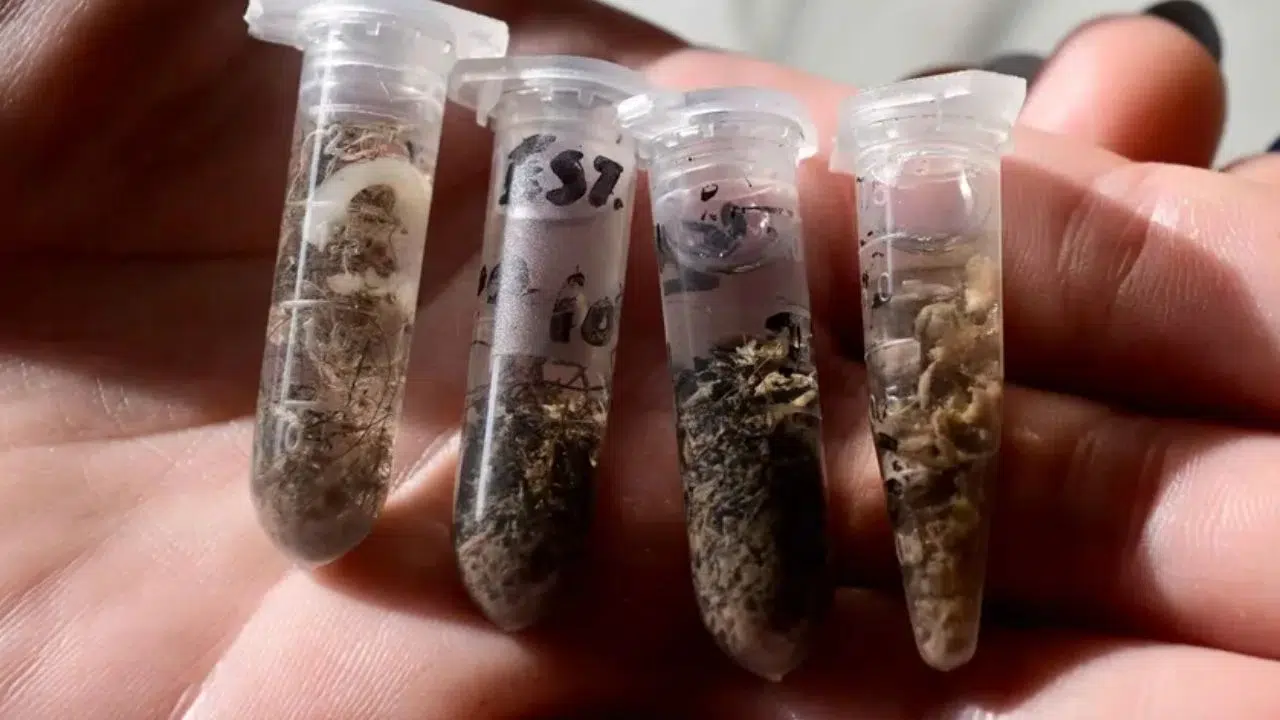
Researchers observed that the sturgeons were thin and malnourished, with few food remains and a large amount of plastics in their stomachs. According to Maiztegui, “the river is extremely polluted” and microplastics create a feeling of satiety, causing the death of native and invasive fish.
This finding reveals that the central problem is not the invasive species, but the critical state of the river ecosystem, affected by sewage discharges, industrial waste, and urban garbage.
Ecological risks: Can the sturgeon establish itself in the Rio de la Plata?
Although there is no evidence of an established wild population, scientists warn that if settled, the sturgeon could expand without natural predators. Its diet, based on bottom invertebrates, could modify the benthic structure of the river.
In its native habitat, the sturgeon lives between 40 and 100 years, migrates between deep and calm areas, and returns to the river to spawn between 8 and 20 years of age. Its longevity and complex life cycle make it a species with high ecological impact.
Crisis in science: underfunding limits environmental monitoring
The project is being developed in a context of underfunding of the national scientific system, where resources are scarce and many inputs must be covered by the researchers themselves.
In this scenario, the role of fishermen is crucial to detect new specimens and expand knowledge about the species.
A campaign to continue researching
Each new sturgeon is an opportunity to understand the impact of the species and the state of the river.
The team plans to relaunch the awareness campaign so that more fishermen collaborate. So far, they have three frozen specimens and could add a fourth one from San Clemente del Tuyú.
Final reflection: beyond the sturgeon, the real problem is pollution
The appearance of invasive species is a symptom of an unbalanced ecosystem.
“The problem is not so much the sturgeon, but the state of our rivers,” concludes Maiztegui. The presence of plastics, waste, and pollutants in the Rio de la Plata should be the focus of urgent attention, beyond the potential impact of an exotic species.
Cover photo: Claudio Velardo



