



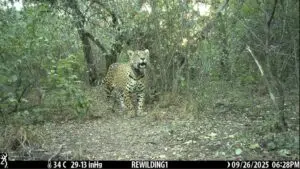
The National Parks Administration (APN) confirmed the intentional damage to the radio collar system of Acaí, a female jaguar released in October in the El Impenetrable National Park, Chaco. The device was found submerged in the Bermejo River, and since then no signals from the animal have been recorded.
Evidence suggests possible third-party involvement, so the judiciary and security forces have been involved. The incident represents a severe blow to the reintroduction program of the largest feline in South America in northern Argentina.
Acaí had been released as part of a joint project between the APN, the Province of Chaco, and the Rewilding Argentina Foundation, with the aim of recovering a reproductive population in the region, where no wild females had been recorded since the 1990s.

The ecological value of Acaí in the Chaco ecosystem
Acaí’s presence represented a historic advance in restoring the natural balance of El Impenetrable. Her return symbolized the possibility of reestablishing the role of the jaguar as a top predator, essential for maintaining control of herbivore species and promoting forest regeneration.
Satellite monitoring, via GPS and VHF collar, allowed tracking of her movement and adaptation to the environment. In the first weeks after her release, Acaí had moved to the Los Manantiales area, where she remained under technical observation.
Her disappearance not only interrupts a key scientific follow-up but also threatens the future of the reintroduced population, delaying years of efforts to ensure the species’ permanence in the Gran Chaco.
Implications of the incident and conservation challenges
The sabotage of Acaí’s collar highlights the persistent risks faced by protected wildlife, even within national areas. These acts compromise the work of ecological restoration and expose the vulnerability of reintroduction programs to human conflicts and lack of territorial control.
The case also demonstrates the need to strengthen surveillance, environmental education, and inter-institutional coordination, to ensure the safety of released specimens. Without a social environment that values conservation, scientific and technical advances are insufficient.
This incident serves as a call to attention on the coexistence between communities, livestock, and wildlife, as well as on the urgency of strengthening effective protection policies and exemplary sanctions for damage to endangered species.
The conservation status of the jaguar in Argentina
The jaguar (Panthera onca) is a critically endangered species in Argentina and is protected by National Law No. 25.463, which declares it a National Natural Monument. Its hunting, harm, or possession are serious environmental crimes.
Currently, it is estimated that fewer than 250 wild specimens remain in the entire country, mainly distributed in the jungles of Misiones, the Chaco, and the northwest yungas. Habitat fragmentation, poaching, and conflicts with livestock activities remain the main threats.
The reintroduction project in El Impenetrable is one of the few active strategies in South America aimed at rebuilding functional populations of large felines, seeking to rebalance degraded ecosystems and recover the Chaco biodiversity.
Continuing the path towards a possible recovery
Despite the impact of this incident, the APN and associated organizations reaffirmed their commitment to the continuation of the restoration program and the strengthening of Chaco biodiversity protection.
Acaí symbolizes years of joint work between scientists, park rangers, and local communities. Her loss or disappearance constitutes an emotional blow, but also a motivation to intensify conservation and surveillance efforts in the region.
The future of the jaguar in Argentina depends on a collective commitment that unites science, justice, and environmental education. Protecting these felines is protecting the balance of forests, rivers, and life itself in one of the country’s most valuable and fragile ecosystems.

