



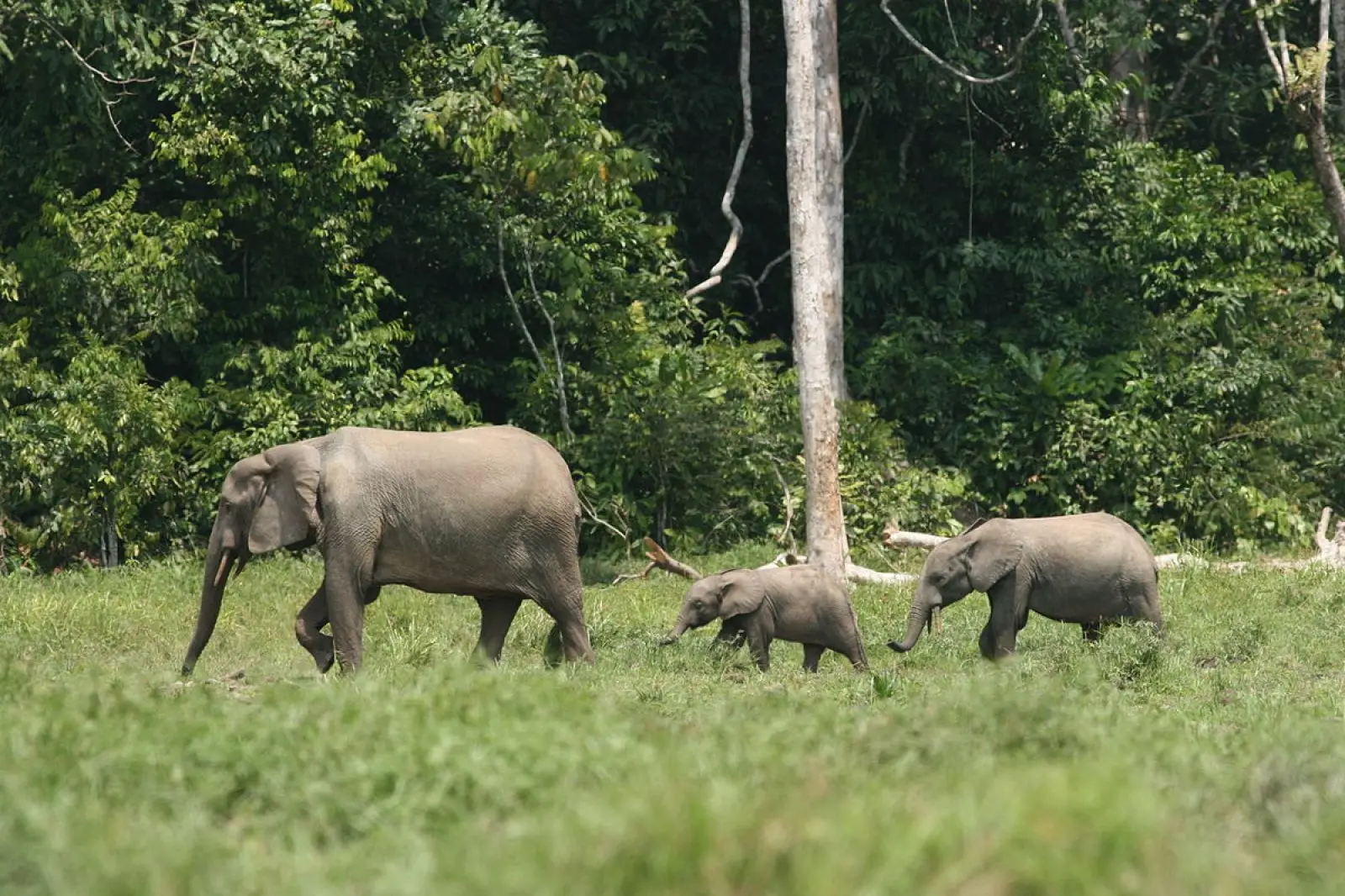
The African forest elephant, smaller and more elusive than the savanna elephant, is considered by scientists and environmental organizations as a true “climate hero.”
Its role goes far beyond biodiversity: by feeding, moving, and dispersing seeds, these animals help the rainforests of Central Africa store more carbon and be more resilient to climate change.
How they contribute to carbon capture
- Forest modification: by knocking down small trees and opening clearings, they favor the growth of larger, dense-wood species.
- Reduction of competition: they allow slow-growing trees with greater carbon storage capacity to thrive.
- Measurable impact: a single elephant can increase a forest’s carbon capture capacity by about 101 hectares, equivalent to removing the annual emissions of more than 2,000 cars.
- Seed dispersal: they transport and deposit seeds through their droppings, regenerating forests and strengthening key species.
- Nutrient cycle: their dung and movement help maintain soil fertility and the circulation of organic matter.
Consequences of their disappearance
The loss of African forest elephants would have a direct impact on the climate: it is estimated that carbon storage in their habitats could decrease by 7%.
This shows that protecting them is not only a matter of biodiversity but also of climate protection.
Main threats
- Poaching: driven by the illegal ivory trade.
- Habitat loss and fragmentation: deforestation and agricultural expansion.
- Human conflicts: crop damage that leads to clashes with local communities.
In recent decades, their population has decreased by more than 86%, placing them in critical danger of extinction.
Conservation efforts
Current programs include:
- Habitat protection: creation of protected areas and biological corridors.
- Combating poaching: cross-border patrols and strict law enforcement.
- Community action: projects to reduce conflicts between humans and elephants.
- Research and monitoring: use of camera traps and wildlife inventories to track populations.
Examples of key protected areas are the Dja National Park in Cameroon and Minkébé in Gabon, where international conservation efforts are concentrated.
The African forest elephant is a natural ally against climate change. Its role as an “ecosystem engineer” allows tropical forests to capture more carbon, regenerate their biodiversity, and maintain their balance.
Protecting them means caring for healthier and more diverse forests and ensuring that nature continues to offer solutions to the climate crisis.



