



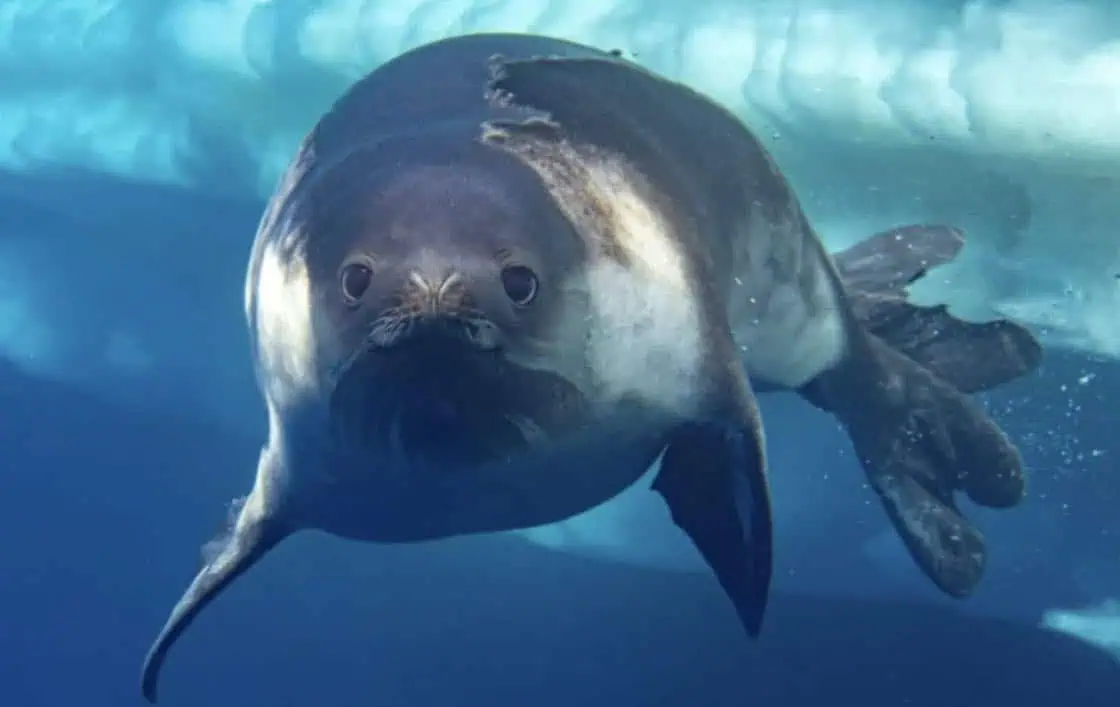
Después de 15 seasons of work in Antarctica, American photographer and naturalist Justin Hofman managed to capture the first underwater images of a Ross seal (Ommatophoca rossii) swimming among the ice.
The discovery, made aboard the cruise ship National Geographic Resolution during a National Geographic-Lindblad Expeditions trip, constitutes the first visual record of this species in its natural habitat.
Hofman recounted that in all that time he had only seen two specimens and that for years he thought obtaining an underwater photograph was practically impossible. The rarity of the encounter and the difficulty of accessing the densest ice banks make this record considered a milestone for science and conservation.
An elusive and solitary species
The Ross seal is the smallest Antarctic pinniped and one of the most mysterious. It lives in areas of compact ice, with solitary habits and distinctive vocalizations that have earned it the nickname “singing seal.” It primarily feeds on squid and fish, and its role as a predator makes it a key regulator of southern marine populations.
Its appearance is characteristic: plump body, thick neck, and small head, with dark gray fur on the back and silver on the belly. Females are usually slightly larger, reaching between 1.7 and 2.5 meters in length and a weight of 160 to 210 kilos.
Ecological importance and conservation
The Ross seal plays an essential role in the Antarctic ecosystem, regulating fish and squid populations. Additionally, its dependence on sea ice for breeding and molting makes it a key environmental indicator in the face of climate change.
It is currently classified by the IUCN as “Least Concern”, with an estimated population between 200,000 and 650,000 individuals. However, the reduction of sea ice due to global warming represents its main long-term threat. Since 1972, the species has been protected by the Convention for the Conservation of Antarctic Seals, in force in Argentina since 1978.
A symbol of polar fragility
Hofman’s record not only provides unprecedented images but also serves as a reminder of the fragility of polar ecosystems. The Ross seal, invisible to most researchers and tourists, becomes a symbol of the biodiversity that still remains hidden beneath the ice.
The viralization of these photographs at the end of 2025 and the beginning of 2026 reinforces the importance of scientific exploration and visual documentation as tools to raise awareness about the conservation of little-known species.


