



This **Wednesday, August 20th**, a total of **136 Magellanic penguins** were found **dead** on **Jurerê Beach**, in **Florianópolis, Santa Catarina**.
The animal monitoring team **PMP-BS/R3** quickly intervened to **remove the bodies** and prevent **contamination risks** for **people and pets** in the area.
Advanced state of decomposition hinders determining the exact cause
Technicians indicate that the animals were already dead at the time of registration.
“All the animals were already dead and in an advanced state of decomposition, which makes it impossible to investigate the exact cause of death,” explained **Tiago Lisboa**, the technician in charge of the collection operation for the **PMP-BS/R3** team.
The impossibility of performing precise necropsies limits the analysis of factors such as **hypothermia, drowning, or [interaction with fishing nets](https://noticiasambientales.com/compromiso-ambiental/lograron-liberar-a-mas-de-3000-corales-y-organismos-marinos-de-redes-de-pesca/)**.
Winter migration: a dangerous journey from Patagonia
During the austral winter, **Magellanic penguins** migrate from their **[colonies in Argentine Patagonia](https://noticiasambientales.com/animales/el-papel-fundamental-de-los-pinguinos-de-magallanes-en-el-equilibrio-ecologico-de-chubut/)** northward, seeking **warmer waters and food**. This journey takes them to the coasts of **Santa Catarina**, where unfortunately, **many do not survive**.
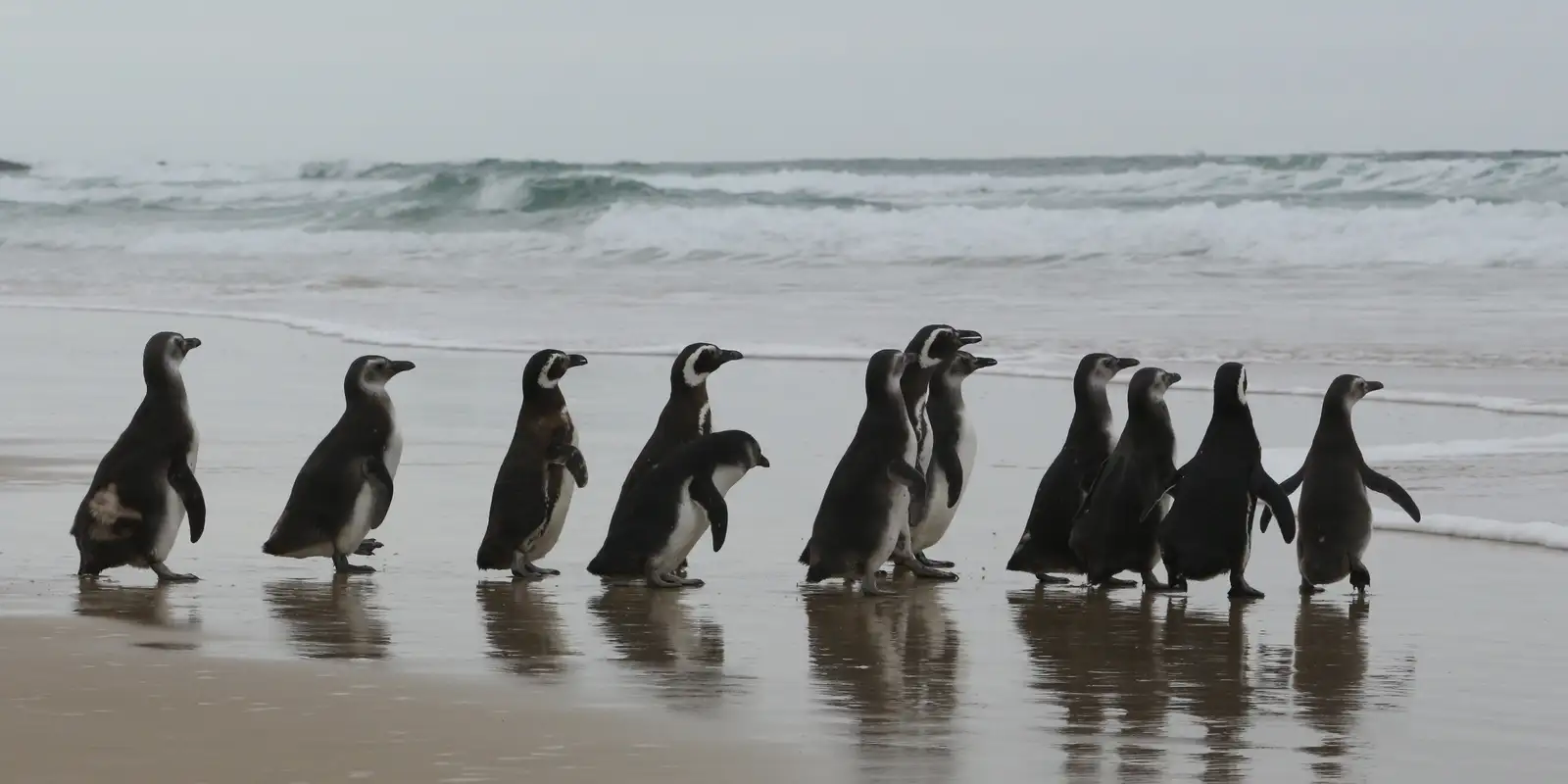
The **deaths mainly affect young specimens**, who due to **inexperience**, become disoriented, fail to feed properly, and end up **stranded on beaches**, showing signs of **exhaustion, hypothermia, and drowning**. There are also cases of **unintentional human interactions**, such as **entanglement in fishing nets**.
Over a thousand specimens recorded this season, but few survive
Since the beginning of the migratory season, **1132 penguins** have been **recorded** on the beaches of **Florianópolis** as of **August 20th**. However, **only 79 were alive** at the time of rescue and were transported to the **[R3 Animal Rehabilitation Center](https://r3animal.org/)**, where they receive specialized care.
The forecast indicates that the **critical period will continue until October**, so **monitoring and response protocols** remain active along the entire coastal region.
Conservation and monitoring: keys to protecting Magellanic penguins
The situation highlights the **need to strengthen conservation actions**, improve **waste management on beaches**, and **reduce the risks of interaction with human activities**. The work of teams like **PMP-BS/R3** is essential to **document cases**, **intervene quickly**, and **raise awareness about the fragility of these migratory ecosystems**.
The Center for Research, Rehabilitation, and Oil Spill Treatment of Marine Animals (CePRAM / R3 Animal) is located in the Río Verzmelho State Park, a conservation unit under the responsibility of the Environmental Institute (IMA-SC), in association with the Military Environmental Police.
*Cover photo: @associacaor3animal*



