



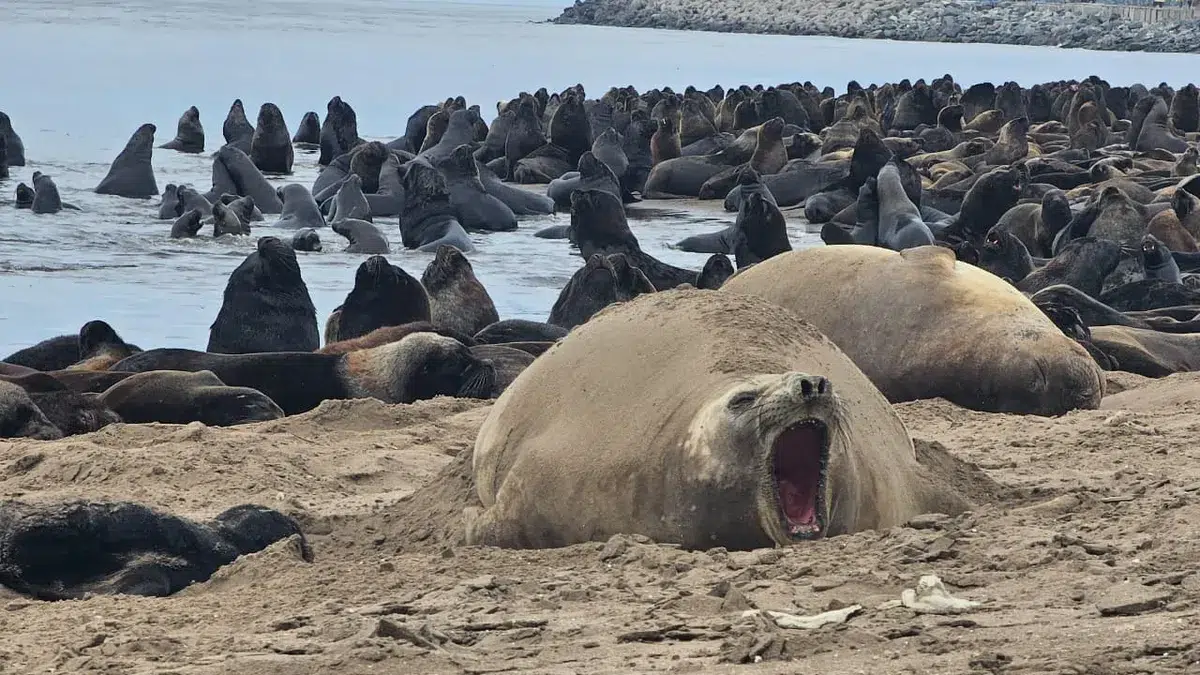
On September 28th, Puerto Quequén was the scene of an unusual and moving event: the birth of a southern elephant seal on the coast of Buenos Aires, among a group of South American sea lions.
The mother chose this place to give birth and care for her offspring, generating surprise among locals, tourists, and specialists.
An increasingly frequent phenomenon in the province
The presence of elephant seals on Buenos Aires beaches is multiplying and requires scientific and community attention.
“We are facing a boom, a true invasion of elephant seals in the region,” says Carolina De León, a researcher at CONICET and a member of IIMyC (UNDMDP).
In the last decade, there has been a sustained increase in individuals in areas such as Mar del Plata, Necochea, and Quequén, even on crowded beaches. What used to be sporadic sightings are now turning into groups of two or three individuals, present throughout the year.
Annual cycle and reproductive behavior
The elephant seal alternates between stages on land and at sea, with moments of high vulnerability.
The species follows a cycle that includes:
- Reproduction and nursing: on land, between September and October
- Molting: also on land, between November and March
- Feeding: at sea, in two periods (2 months and then 6–7 months)
During nursing and molting, both females and pups are exposed to physical risks and stress, so maximum respect and distance are required.
Possible causes of distribution change
Population growth and avian influenza may be altering the species’ behavior.
“The population has been steadily growing for years,” explains De León. “Furthermore, mortality due to avian influenza in Península Valdés may have led to a displacement towards new resting and breeding areas.”
This change requires reviewing the role of the Buenos Aires coast as an active distribution site, and strengthening scientific monitoring to understand and support this transformation.
Recommendations for responsible coexistence
How to act in the presence of elephant seals on urban or natural beaches.
- Notify authorities or environmental entities
- Do not touch or feed the animals
- Respect their space (they can be approached with visible barriers)
- Avoid noise, shouting, or sudden movements
- Keep pets away
“They are large wild animals that can react to stress or in defense of their offspring,” warn from Consorcio de Puerto Quequén.



