



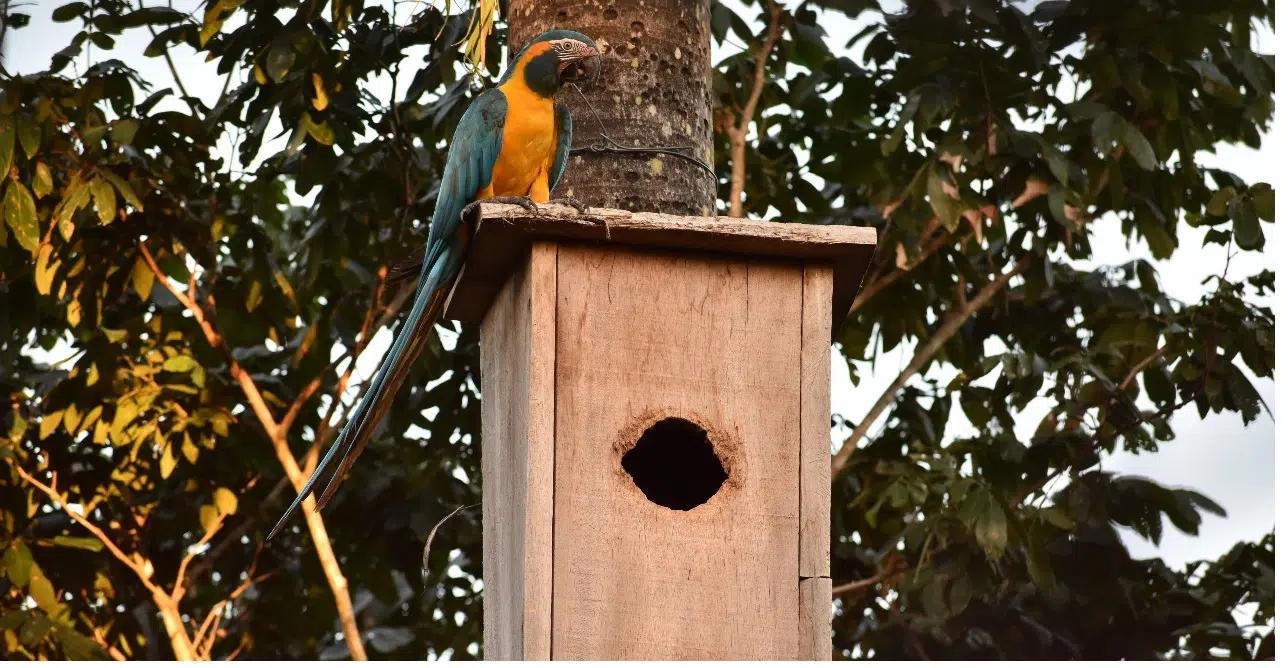
The Blue-throated Macaw Nest Box Program (Ara glaucogularis), driven by the Asociación Armonía, celebrates 20 years with results that mark a before and after in the conservation of this endemic species of Bolivia and in Critically Endangered status.
When it began in 2005, there was barely an attempt at reproduction and no chicks survived. Today, the initiative breaks records year after year: in the 2025 season, 19 chicks successfully fledged, raising the total to 164 chicks that have taken flight since the program’s inception.
Recent Results
- 2025: 19 chicks fledged, from 12 nesting attempts and 32 eggs laid in 128 nest boxes.
- 2024: 17 chicks successfully fledged.
- 2023: 15 chicks took their first flight.
The trend shows a sustained improvement in reproductive success. Today it is estimated that one in four wild blue-throated macaws was born in a nest box installed by Armonía.
Success Rates
Of the 32 eggs laid in 2025:
- 24 chicks hatched (75% hatch rate).
- 19 successfully fledged (79% success among those hatched).
- Six nests recorded total survival.
- The PBA15 nest was the most productive, with four eggs and three chicks that fledged.
These results contrast with previous seasons, such as 2022–2023, when 46 eggs were documented but more than half failed to hatch.
Observed Behaviors
Trap cameras revealed unprecedented details:
- Less competition with other species, but more territorial disputes between macaw pairs.
- In one case, a pair stopped feeding their chicks to confront another, which required intervention with supplementary feeding.
- In another episode, the parents forgot to carve the exit hole of the artificial nest, and the park ranger César Flores had to enlarge it to allow the chick to fledge.
The Laney Rickman Reserve
Created in 2018 in the Llanos de Moxos, the reserve is now a stronghold for the species. There, the following are combined:
- Habitat protection.
- Restoration of native palm groves.
- Sustainable savanna management.
- Environmental education.
This comprehensive approach has allowed the nest boxes to evolve from an experiment into a key tool to prevent extinction.
Projections
The program took 16 years to reach its first 100 fledged chicks. At the current pace, it is expected to reach 200 before 2027, reflecting the consolidation of technical and scientific work on the ground.
The case of the Blue-throated Macaw demonstrates that innovation applied to conservation can reverse critical trends. What began as an isolated attempt is now a replicable model that combines science, community commitment, and habitat management.
Each new flight is a triumph for Bolivian biodiversity and a reminder that perseverance can save species on the brink of disappearance.


